The Design Brief® | Remembering Frank Gehry: His Work and Legacy

©️ Dakota Design Company 2017-2026 | All rights reserved. This content may not be reproduced, distributed, or used without permission.
WRITTEN BY DR. GLORIA for DAKOTA DESIGN COMPANY
Frank Gehry, one of the most remarkable and creative talents in the history of American architecture, died on December 5th, 2025, at the age of 96. He will be remembered for his awe-inspiring, hugely memorable buildings, and for the simple fact that he challenged the most basic and long-standing premise in building construction throughout the ages: that walls should be straight and perpendicular to the ground.
Although one of America’s most renowned architects, Gehry is perhaps best known for a building in Spain: the Guggenheim Museum in Bilbao. It is a joyful, exuberant structure that appears to have burst from the ground in a free-flowing form. Clad in glittering titanium, its glistening exterior beckons you to come inside and explore its treasures. When this museum opened in 1997, it revitalized the city and established Gehry as an icon of modern-day architectural exploration.

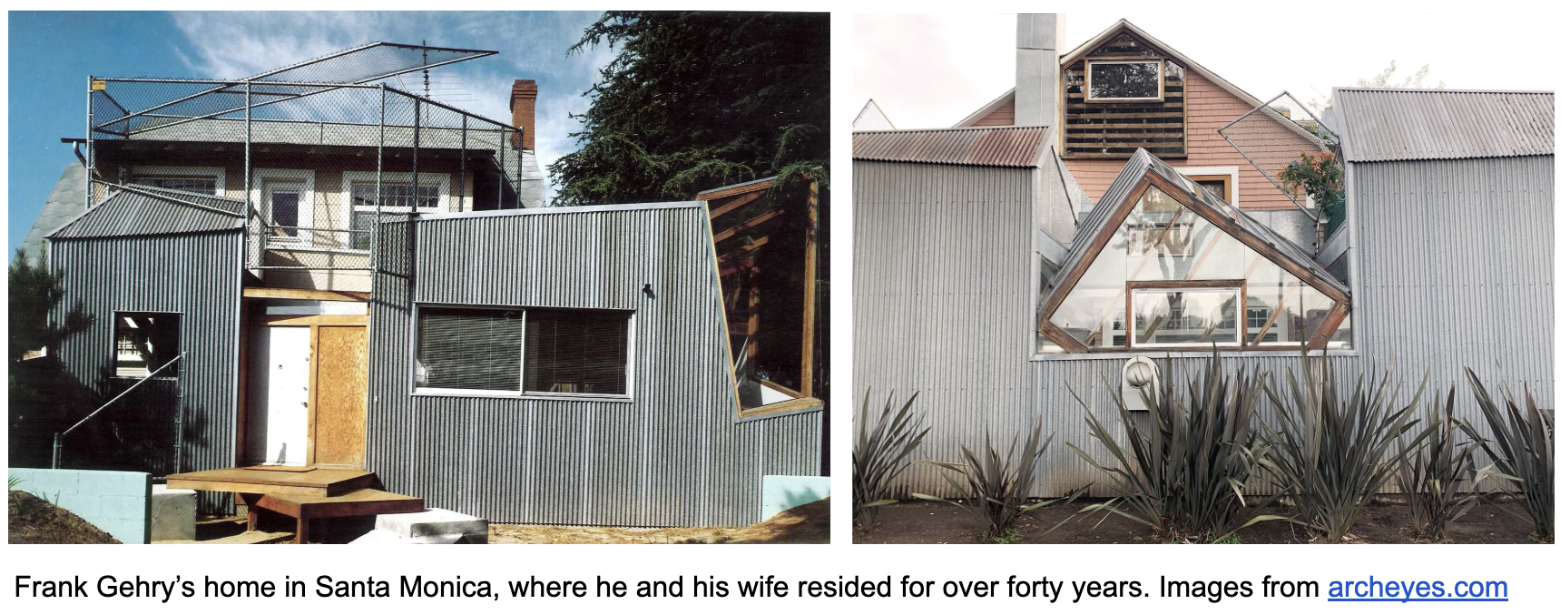
But the Guggenheim Bilbao was only one of Gehry’s many architectural explorations. One of his early projects was to transform a modest home in Santa Monica, California, where he and his wife lived for decades. Originally a simple Cape Cod bungalow, he transformed it with an envelope of corrugated metal, plywood, and chain link fence to arrive at a wholly unique residential form. Apparently, not all of his neighbors were happy about the structure, but it did earn him significant recognition in the local architectural community.
Gehry was very attuned to how people encounter his buildings, and that the building’s form itself adds to the experience of being there. He capitalized on ways the built environment's space and form can significantly impact people’s mental and physical well-being. It is not possible to walk into a Frank Gehry building mindlessly. The building itself strongly impacts its inhabitants. Maggie’s Center, in Dundee, Scotland (below left), is such a building. A cancer treatment center, with its simple, humble form, was designed to foster rest, tranquility, reflection, and introspection. And the Lou Ruvo Center for Brain Health in Las Vegas, Nevada, is intended, I believe, to prompt patients to reflect on a world and an experience that extends beyond their illness and treatment.

Many of Gehry’s designs are whimsical, fun-spirited, and provocative. The Norton House, built for a client on a narrow, ocean-front lot on the Venice Beach Boardwalk in California (below left) is an unexpected combination of everyday materials and beach references. In 1991, Gehry collaborated with sculptor Claes Oldenburg to create office space for Chiat Day Advertising agency. Also known as the Binocular Building (below right), the huge binoculars form the front entrance to the building and parking lot.

Some of Gehry’s most recognized architectural masterpieces include, all pictured below:
The Vitra Design Museum (1989) in Germany
The Weisman Art Museum (1993) in Minneapolis, Minnesota
The Dancing House building (1996) in Prague, also known as Fred and Ginger, because it resembles two dancers in an embrace
The Walt Disney Concert Hall (2003) in Los Angeles, California
8 Spruce (2011) in Manhattan, New York
Fondation Louis Vuitton (2014) in Paris, France
These buildings clearly illustrate Gehry’s exploration of shape and form, and his innovative use of exterior materials. No other architect in the world has created more unusual or provocative buildings than Frank Gehry.

As with everything that is highly unusual, revolutionary, and cutting-edge, Gehry had his detractors along with his admirers. Some architectural critics found his designs garish, overpowering, and flamboyant, and an assault on architectural traditions. But mostly, the world has recognized his designs as the most evocative and revolutionary in American architecture.

I encourage every reader of this post to watch the 2006 90-minute documentary Sketches of Frank Gehry, produced by Hollywood director Sydney Pollack. It is currently available on both Amazon Prime and Apple TV for a rental fee of less than $4. It delves into Gehry’s creative process and explores his formidable talent juxtaposed with his “Aw, shucks” everyday-man-on-the-street brand of humor and unpretentiousness. It is really a must-see to appreciate Gehry’s approach to design, his full body of work, and his impact on American architecture.
Sources Used:
Sheth, S. (2025, December 5). 10 iconic Fran Gehry buildings that celebrate the “Starchitect’s” legacy. Yanko Design. https://www.yankodesign.com/2025/12/05/10-iconic-frank-gehry-buildings-that-celebrate-the-late-starchitects-legacy/

Want The Design Brief® delivered straight to your inbox?
If you liked this article, be sure to sign up for The Design Brief®, our complimentary publication that gives you bite-sized lessons on all the technical interior design topics you didn’t learn (or forgot) from design school—straight from our resident tenured interior design professor!