The Design Brief® | History Series: American Historic Furniture Styles

©️ Dakota Design Company 2017-2026 | All rights reserved. This content may not be reproduced, distributed, or used without permission.
WRITTEN BY DR. GLORIA for DAKOTA DESIGN COMPANY
Historic American furniture styles are extremely varied and diverse. They were influenced by a wide range of European settlers who immigrated here and brought their own stylistic heritage, as well as by designers who shaped trends with their unique American sensibilities.
European Stylistic Influences across North America

During the 1500s, and 1600s, early Spanish settlers conquered and occupied what is now Florida, Texas, Arizona, Southern California, and Mexico. The Spanish strove to impress native populations and to demonstrate their superiority with construction techniques. Delve more into Spanish-influenced architecture in North America here.
The French did not occupy as much of the Americas during this colonization period as the Spanish, but they did settle in northeast Canada, across the Midwest, and down to Louisiana. The most lasting impacts of early French settlers in architecture and design can be seen in Louisiana, along the Mississippi River, and in southeastern Canada, as described here.
The Dutch (from the Netherlands, previously known as Holland) settled along the eastern seaboard, particularly in New Jersey and New York. German migrants settled in what is now Pennsylvania. Their legacy in architecture and design is explored here.
The Spanish, French, Dutch, and Germans were not the main nationalities to settle in colonial America. It was the BRITISH who were the most predominant settlers. They came not only to explore the new world, but also to flee political and religious upheavals in Europe. Learn more about their architectural and furniture traditions here.
Furniture Styles in Early America
Particularly in the east and northeast, in English settlements, simple, easy-to-build chair styles that were uniquely American became predominant. The ladder-back chair was one such design that was straightforward for carpenters to make, and remained popular from the late 17th through the 18th century. The back included several horizontal rails, and the seats were made of rush (a wetland grass-like plant) or cane (woven palm fronds called rattan).
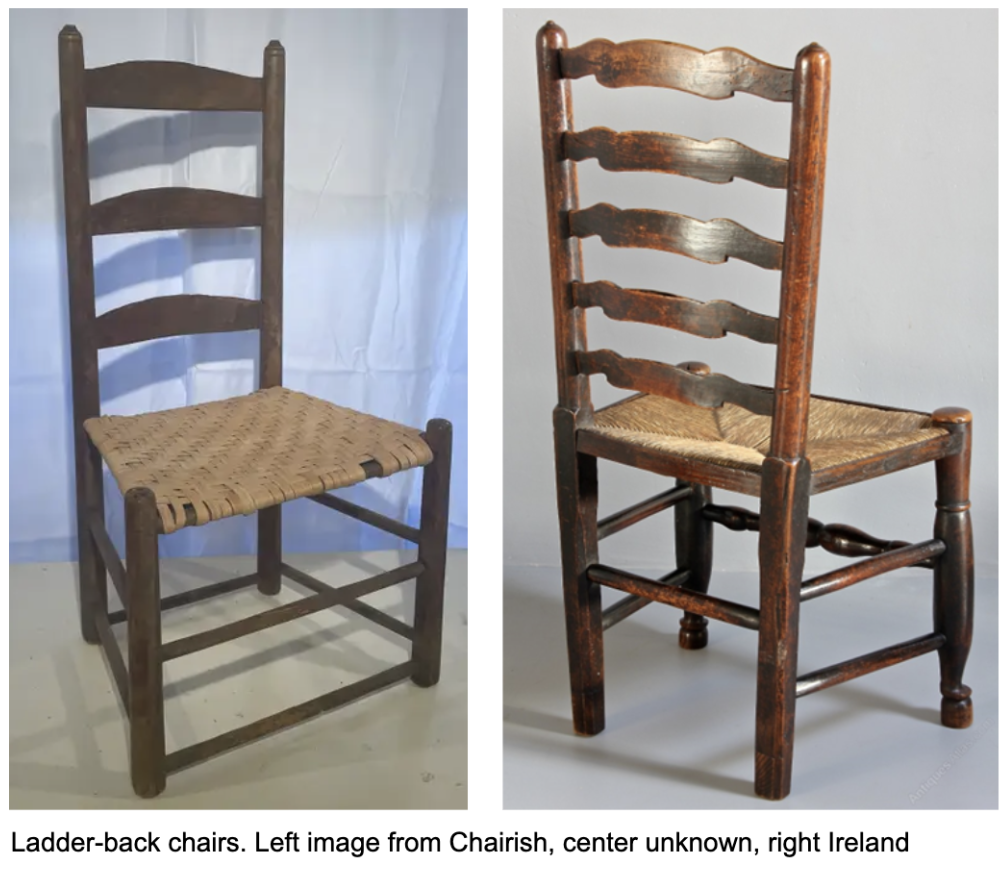
The wainscot chair design was borrowed from England, but in America, the design was less ornate, with less elaborate back panels.

Chairs that were mostly composed of spindles and finials, turned on a lathe, included the Brewster chair and the Carver chair. The Brewster chair had turned (turned on a lathe) vertical spindles, a rush seat, and runners between the legs. The Brewster chair included a double row of spindles on the back. The Carver chair had a single row of vertical spindles on the back, and finials on the top of the front legs, above the arms.

We often think of the spindle-back Windsor chair (pictured below) as the quintessential early American chair style. But in reality, the British brought this chair style to the United States from their homeland. There are several key differences compared to other traditional chairs. The Windsor seat is made of wood and features a saddle, or dish shape, for comfort. The back and legs are inserted into drilled holes in the top and bottom of the seat with mortise-and-tenon joinery, whereas other chairs have back legs and uprights that are continuous. And the Windsor legs are splayed significantly, rather than vertical. The back top rail was steam-bent to create the characteristic bow.

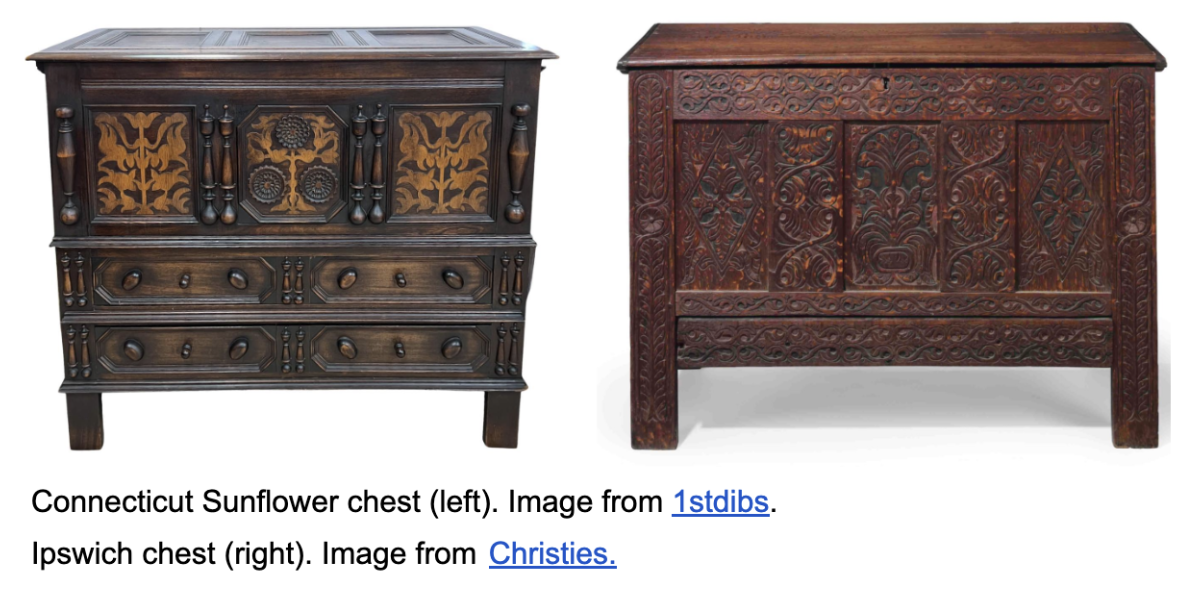
A Connecticut sunflower chest was a storage piece with two drawers, and three carved panels across the top, the center one featuring carved sunflowers. An Ipswich chest was another type of carved storage cabinet.
The William and Mary Period (1690-1730)
This period, named for Queen Mary II of England and her husband, William of Holland, originated in England, but was also influential in the American colonies. This was roughly the same period as Louis XIV in France. This design period in England and the colonies emphasized verticality in furniture. The Banister chair typically included carved rails at the top of the tall back, and distinctive vertical back slats or banisters, as used in a stairway railing.
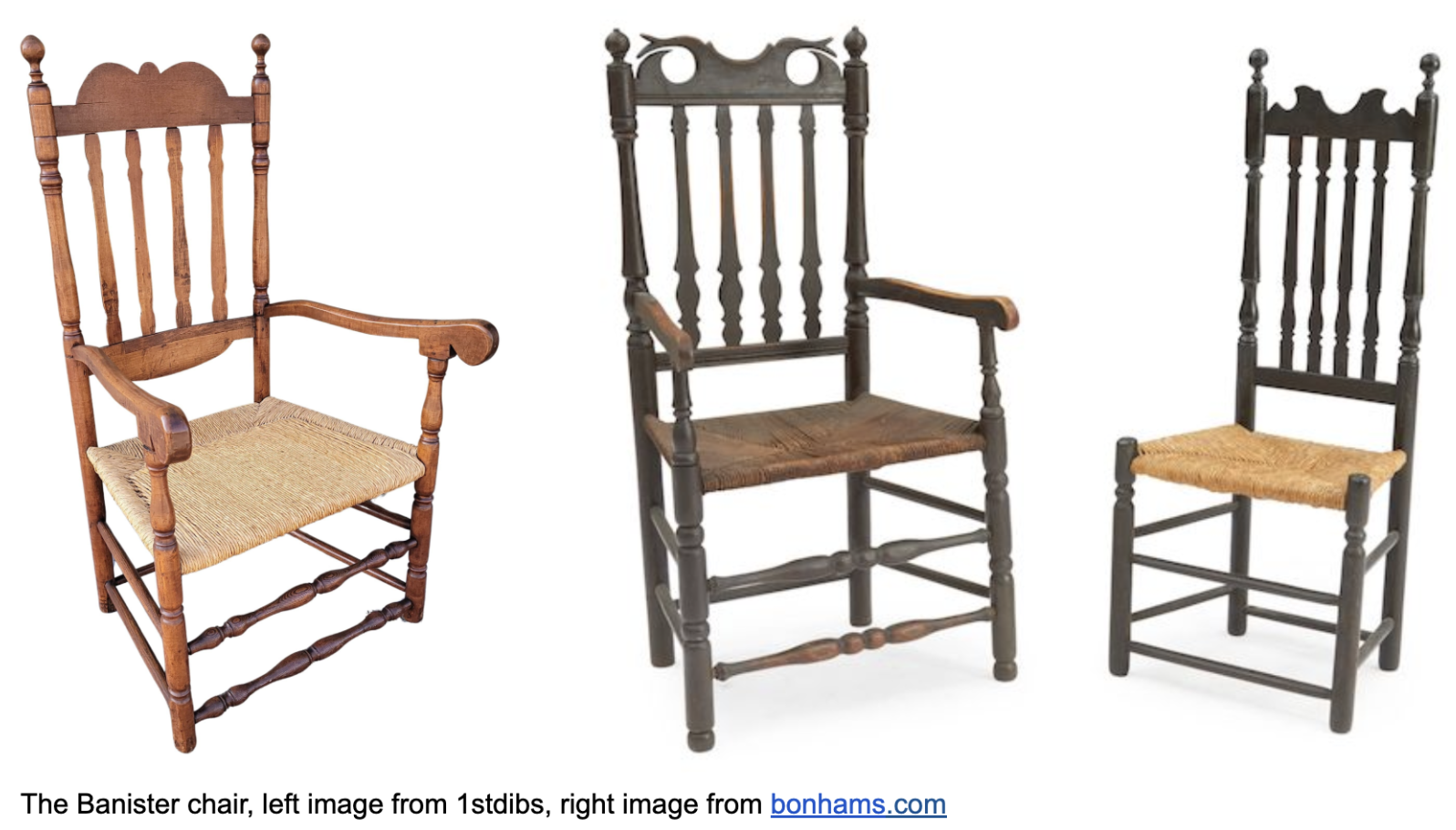
The Boston chair was a purely American innovation in the early 18th century, and was fairly simple and easily produced. The back support was slightly S-curved backwards for comfort, and the front stretcher was typically turned. Leather upholstery and nailhead trim were often used. Sometimes a paintbrush foot was used, as seen below left

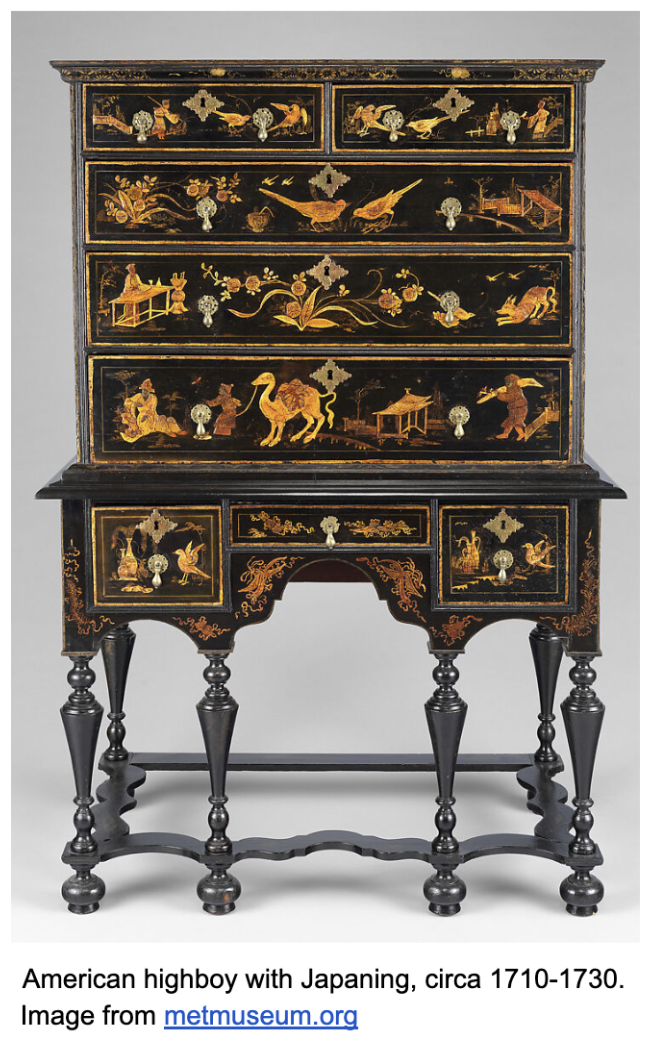
By this time, a chest of drawers had replaced other storage pieces, such as the Connecticut and Ipswich chests. At this period, they often had tall, turned legs, which is why these chests were called highboys.

A similar chest, with only a few drawers, was called a lowboy. Drawer construction became more refined, and the use of dovetail joints on drawers became more predominant.

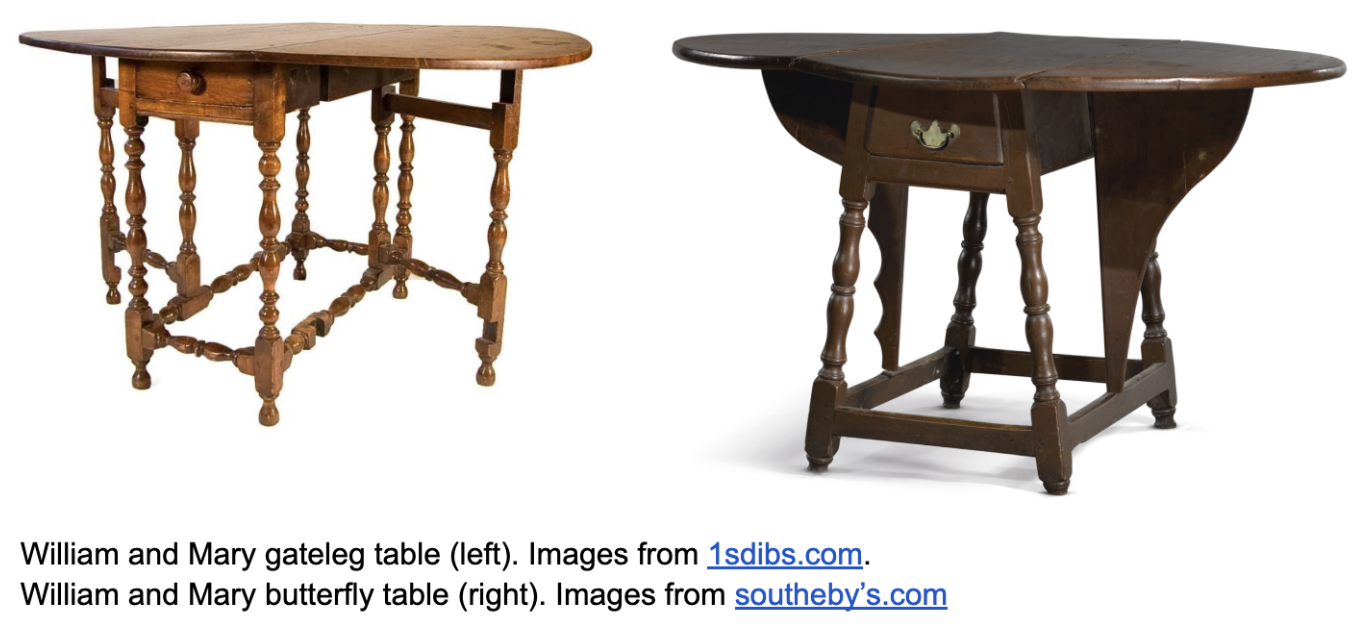
The gateleg and butterfly tables had been used prior to the William and Mary period, but now the legs became more delicate. In a gateleg table, the side legs pivot outward to support a drop leaf, which hinges upward. A butterfly table is also a drop leaf table, but has supports that swing out to support the leaves. The serpentine curves of the supports suggest the wings of a butterfly.
During the William and Mary period, a chair style that today we would call a wingback chair, emerged in popularity, but if it is from this period, it is known as an easie (or easy) chair. Its padded upholstery made it comfortable, and the side wings protected the user from drafts.

The use of a technique called Japaning became popular with American William and Mary furniture. The goal was to achieve the look of Japanese lacquering, which was a method using the sap of a tree to create a very hard and shiny finish. In American Japaning, no actual lacquer was used. Instead, the wooden piece was hand-painted to resemble lacquering. Paints were often made of metal leaves and powders, or gold paint, depicting chinoiserie scenes. Then varnish was applied over the top.
American Neoclassical Furniture
At the time of the Neoclassical period in France (Louis XVI), the Georgian period in England (Chippendale, Hepplewhite, and Sheraton), the Empire period in France (Napoleon Bonaparte), and the Biedermeier period in Germany, there were two notable furniture designers in America. Furniture designer Duncan Phyfe (1770-1854) was influenced by both Thomas Sheraton and the Empire style in France.

One well-known Phyfe piece is the round occasional table with splayed (outwardly curved) legs. Another is the chair with the lyre back.
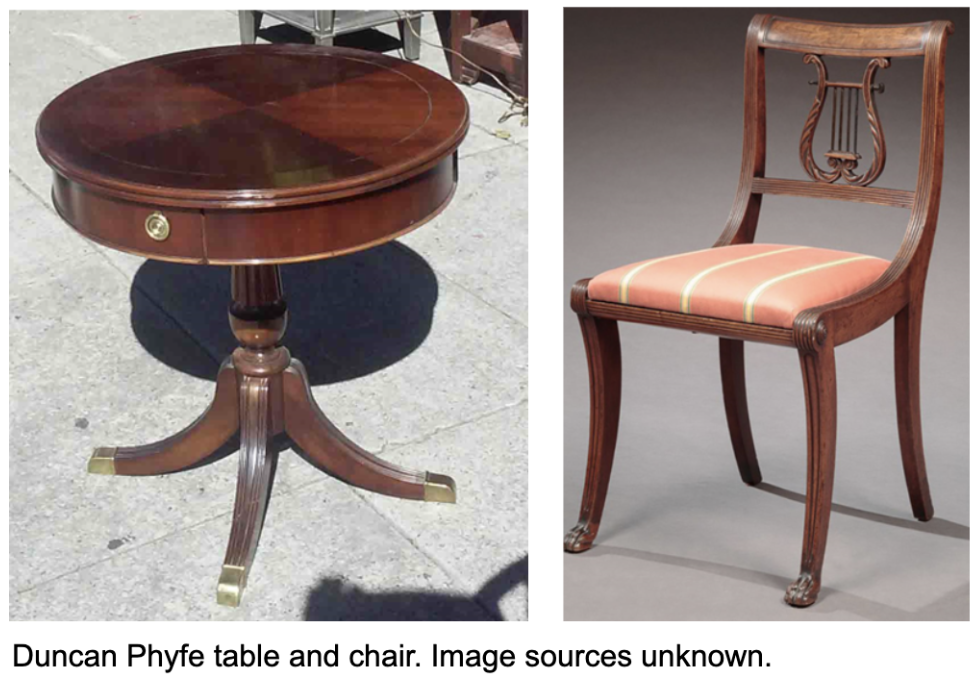
He often used these two elements, the splayed leg and the lyre, in addition to carved wooden or metal feet that resembled animal feet.

Lambert Hitchcock (1795-1852) developed very distinctive chairs (called Hitchcock chairs) that were fairly inexpensive for American homeowners to purchase. They were often painted black, and the back crest rail was curved, and usually painted with flowers or fruit. Seats were either wooden or rush.

Victorian Furniture
The 19th century (the years of 1800-1899) is known as the Machine Age, where work done manually by humans for thousands of years could now be done by machines in factories. This changed life drastically, and allowed the middle classes to afford mass-produced factory furniture pieces at lower costs.
The period from 1837 to 1901 in both Britain and America is known as the Victorian period, named after England’s monarch at the time, Queen Victoria.
Victorian furniture had these commonalities:
Curvaceous silhouettes with extensive ornamentation
Oval framed portions within upholstered furniture
Rich fabrics, such as velvets, damasks, needlepoint, and brocades, in rich, saturated colors
Ornate carvings. Scrollwork, floral motifs, acanthus leaves, and intricate lattice patterns used on chair backs and table legs
Furniture was large-scaled and stately
Dark woods, such as mahogany, walnut, and rosewood, were used
Button tufting used on the backs of upholstered chairs and settees
S-shaped cabriolet legs

The typical Victorian sofa was called a Show Frame – as the frame was exposed and not covered with upholstery.

Balloon-back chairs, with a balloon-shaped backrest, were very popular.
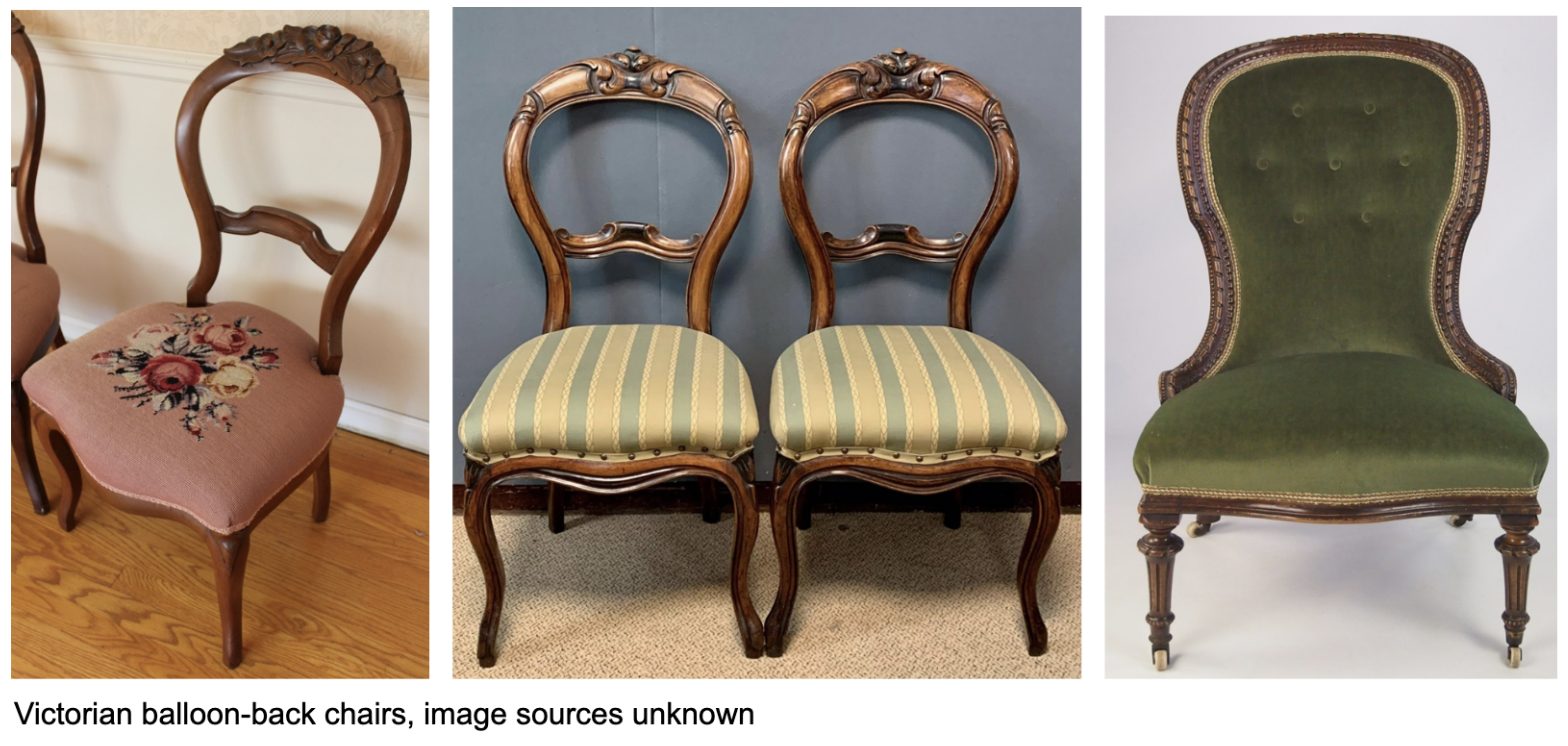
The Victorian Slipper chair was a sleek chair style without arms.

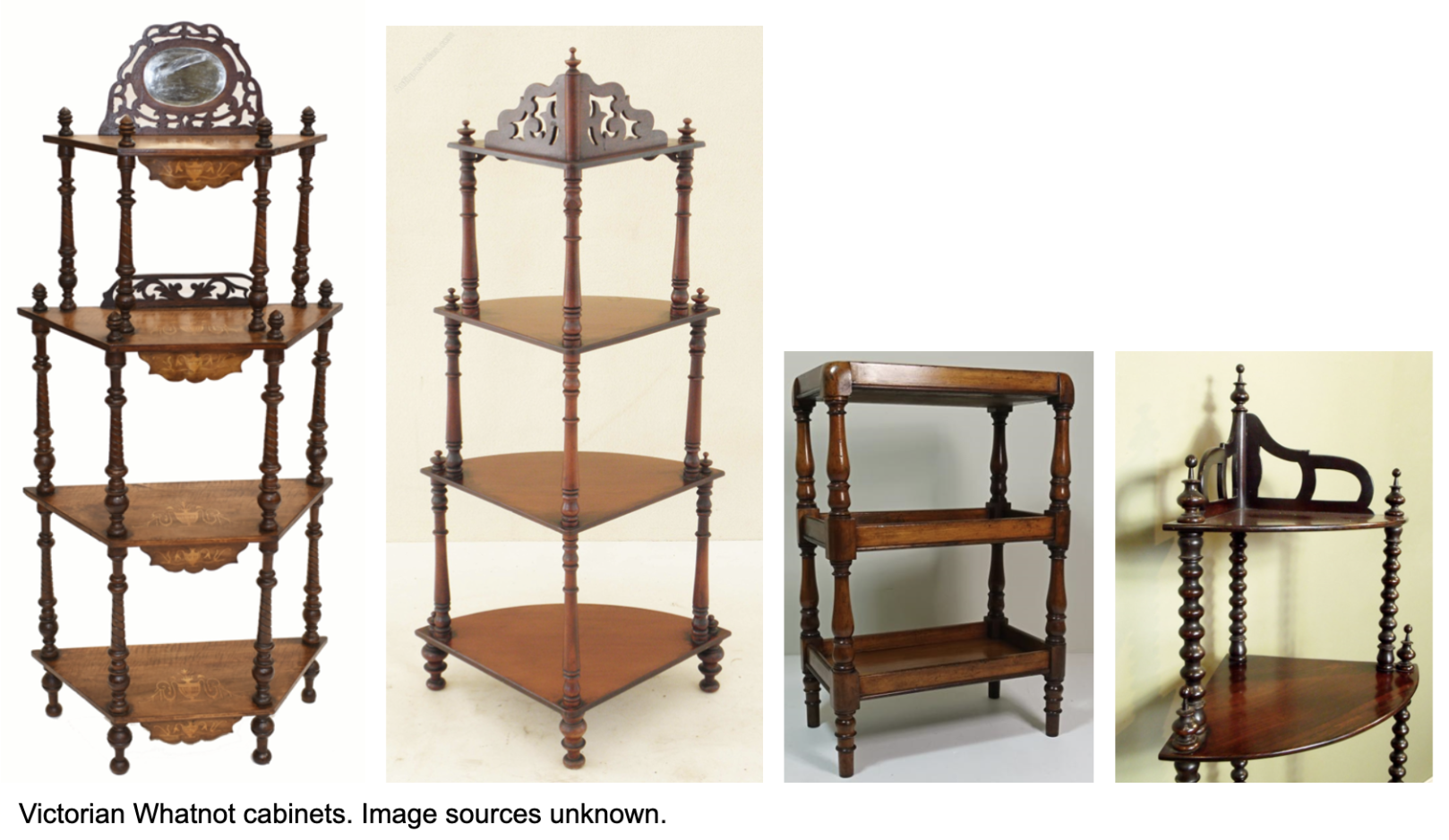
A Victorian Whatnot cabinet was an open wooden shelving unit with carved spindles, like an etergere. Sometimes they were triangular-shaped to fit into corners.
A Victorian Sutherland table was a drop-leaf or gate-leg table. The leaves were large, so that the central portion was narrow and took up less space when folded down.

Charles Eastlake was an English furniture designer who embraced minimal decorations and clean lines–quite different from other Victorian-era furniture happening at the time. In the early 1870s, his ideas traveled from England to America, where large furniture manufacturers adopted the style. Eastlake furniture was popular from approximately 1870 to 1890.
Commonalities included:
Geometric and rectilinear shapes- squares, rectangles, diamonds, and half-circles, no scrolling, ribbons, or fancy curving motifs
Shallow carvings and etchings that tended to be nature-inspired: flowers, acorns, or leaves
Straight Lines: horizontal and vertical stacked incised lines
Use of oak, walnut, or cherry: lighter-colored woods than other Victorian furniture

Jenny Lind furniture was named for a popular American opera singer of the time. The key characteristic was the repeated “spools” created on a lathe. We often see this style used today for children's furniture (image below right).

Arts and Crafts Furniture
The Arts & Crafts (aka Craftsman) period was from about 1880–1915. It was a reaction against the excesses of Victorian style and against machine-produced furniture manufacturing. Proponents felt that craftsmen should be respected for their work and talents, and that truly high-quality furniture could only be produced by hand. The movement began in England with William Morris (learn more here). But the American designer and furniture maker Gustav Stickley (1848-1952) also forwarded the idea that design and furniture should have a simple, naturalistic, and handmade quality. Arts and Crafts furniture was almost always made of oak, which has strong and very apparent grain lines.

A common Stickley piece was the Barrister cabinet, featuring tilt-up, recessing doors.

Art Deco Furniture
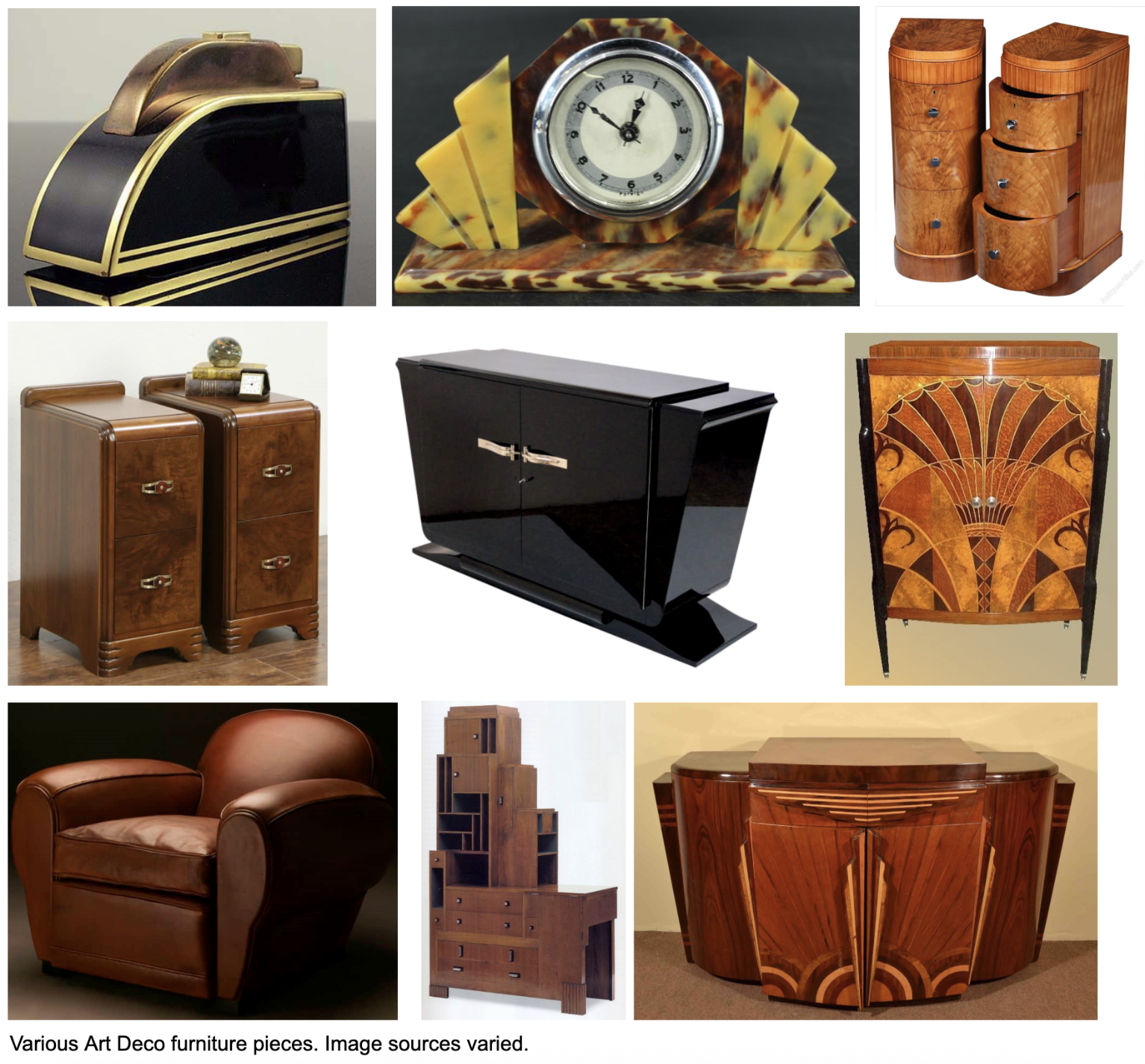
This style, which prevailed in the late 1920’s and 1930’s, is called ART DECO. It is a style that capitalizes on the look of sleekness, technology, and speed. It used strong geometric shapes, particularly triangles and diamonds.

These motifs can be seen in architecture of this period. The Chrysler Building, in New York, completed in 1930, is a beautiful example of Art Deco architecture.
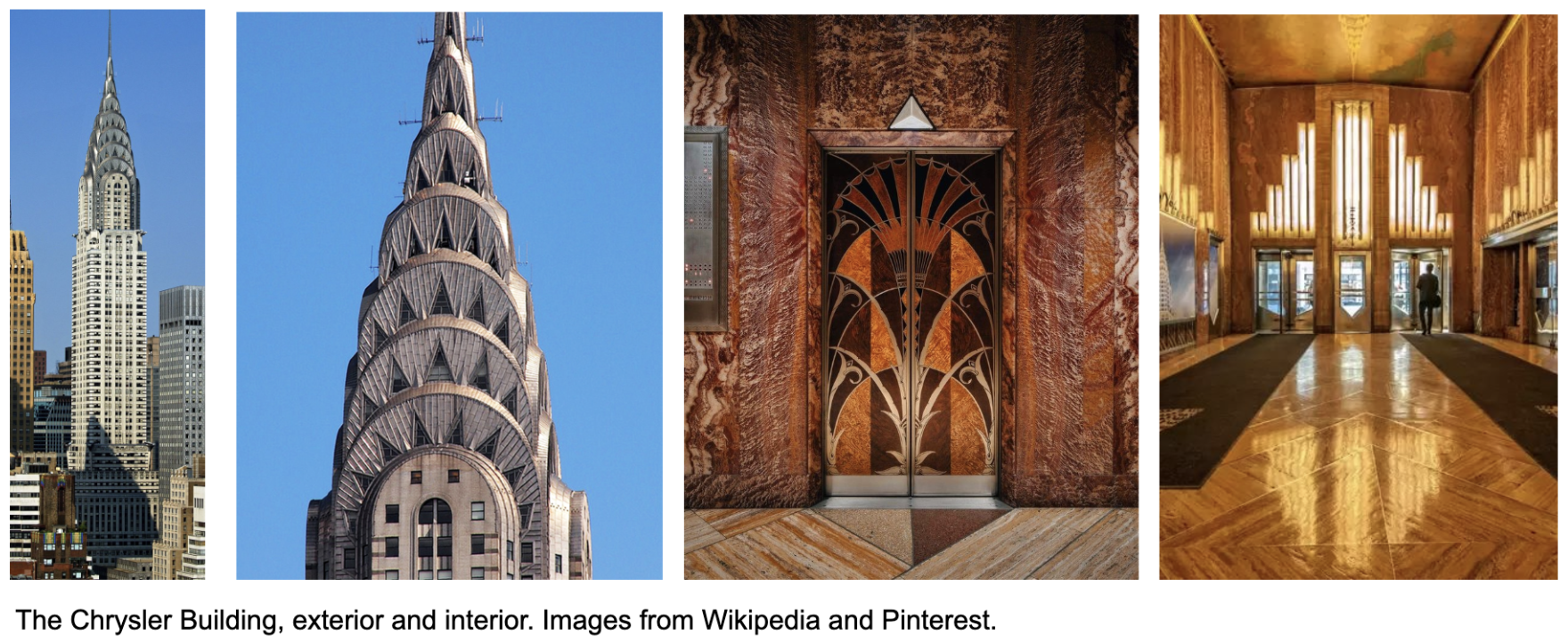
An event that impacted Art Deco styling was the discovery of the tomb of King Tutankhamun (King Tut) in Egypt in 1922 by excavators, more than 3,300 years after Tutankhamun's death and burial. Photos of the found artifacts were published in the media, sparking an interest in Egyptian motifs. Art Deco designers incorporated many of the decorative elements from ancient Egyptian culture.

Characteristics of Art Deco design include:
Geometric shapes
Streamlined forms
Stepped forms reminiscent of ancient structures
Strong colors
Exotic woods, animal skins, ivory, and tortoiseshell
Rounded and angled edges
Use of lacquer and wood inlays
How to Differentiate Between American and British Antique Furniture
An interior designer recently asked about ways to tell the difference between American and British antique pieces. This can certainly be difficult, and there are many factors to consider. It is key to know where the style originated, for instance, with a Chippendale chair (British) or a Hitchcock chair (American). But many similar designs were produced on both sides of the Atlantic.
There are some generalities that can suggest—but not definitively determine—the likely origin. One general rule of thumb is that British furniture tends to be more elaborately detailed. Take the antique highboys below. English highboys tended to have a complete pediment on the top (left), where American highboys more often had simple moldings at the top. Of course, there are exceptions to this generalization.

If you look in inner drawer construction, fine, tight, tiny dovetails with narrow necks are more typically English. Fatter, more rustic dovetail joints are more likely to be American-made. Again, this is a generality, not a proof.
If you look carefully at dovetail joints, you can tell whether they are hand-cut (below left) or machine-cut (below right). Machine-cut dovetails will be perfectly matched and precise, with each tail and pin identically produced. Machine-cut dovetails indicate the piece is more likely to be American-made, as the British clung to hand-made craftsmanship for a longer period.

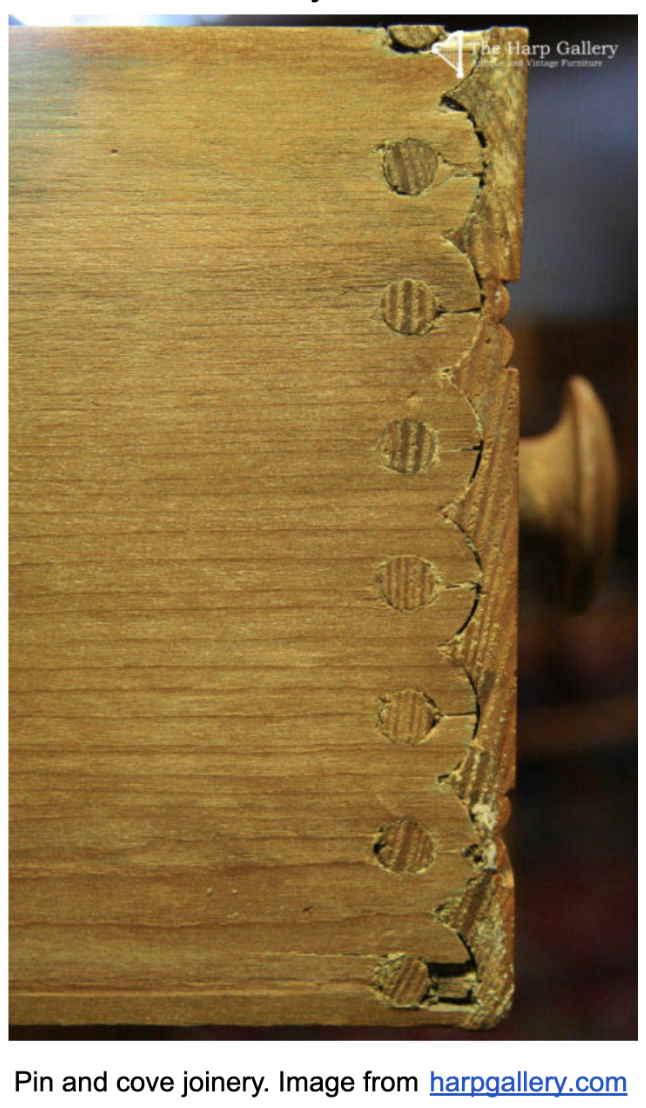
One type of joinery that is distinctly American is the pin and cove method. This joinery on drawers most likely indicates an American piece.
Wood species can also be an indicator of British versus American origin. Primary woods are those used on the exterior of furniture pieces because they are more expensive. Drawer frames, sides, backs, and bottoms were often made of lesser-priced, more plentiful woods, called secondary woods. Again, a generality, but mahogany as a primary wood tends to indicate British origin, and walnut, maple, or cherry would be more indicative of an American-made piece. Oak, as a secondary wood, is more indicative of a British piece, and poplar or pine, as a secondary wood, is more likely associated with American-made.
Of course, always rely on dealers' and sellers' expertise to provide context when shopping for antique pieces. They will be best able to interpret any markings or stamps that indicate origin.
Sources Used:
Harp Gallery, (2025, January 2). Dovetails - A clue for dating antiques. https://www.harpgallery.com/blog/dovetails-a-clue-for-dating-antiques/
Ireland, J. (2018). History of interior design, 2nd edition. Fairchild Books.
The Virginia Pilot. (2008, March 14). English or American Antique? https://www.pilotonline.com/2008/03/14/english-or-american-antique/
Wikipedia. (n.d.). Windsor Chair. https://en.wikipedia.org/wiki/Windsor_chair

Want The Design Brief® delivered straight to your inbox?
If you liked this email, be sure to sign up for The Design Brief®, our complimentary publication that gives you bite-sized lessons on all the technical interior design topics you didn’t learn (or forgot) from design school—straight from our resident tenured interior design professor!