The Business Shifts Interior Designers Can’t Ignore in 2026

©️ Dakota Design Company 2017-2026 | All rights reserved. This content may not be reproduced, distributed, or used without permission.
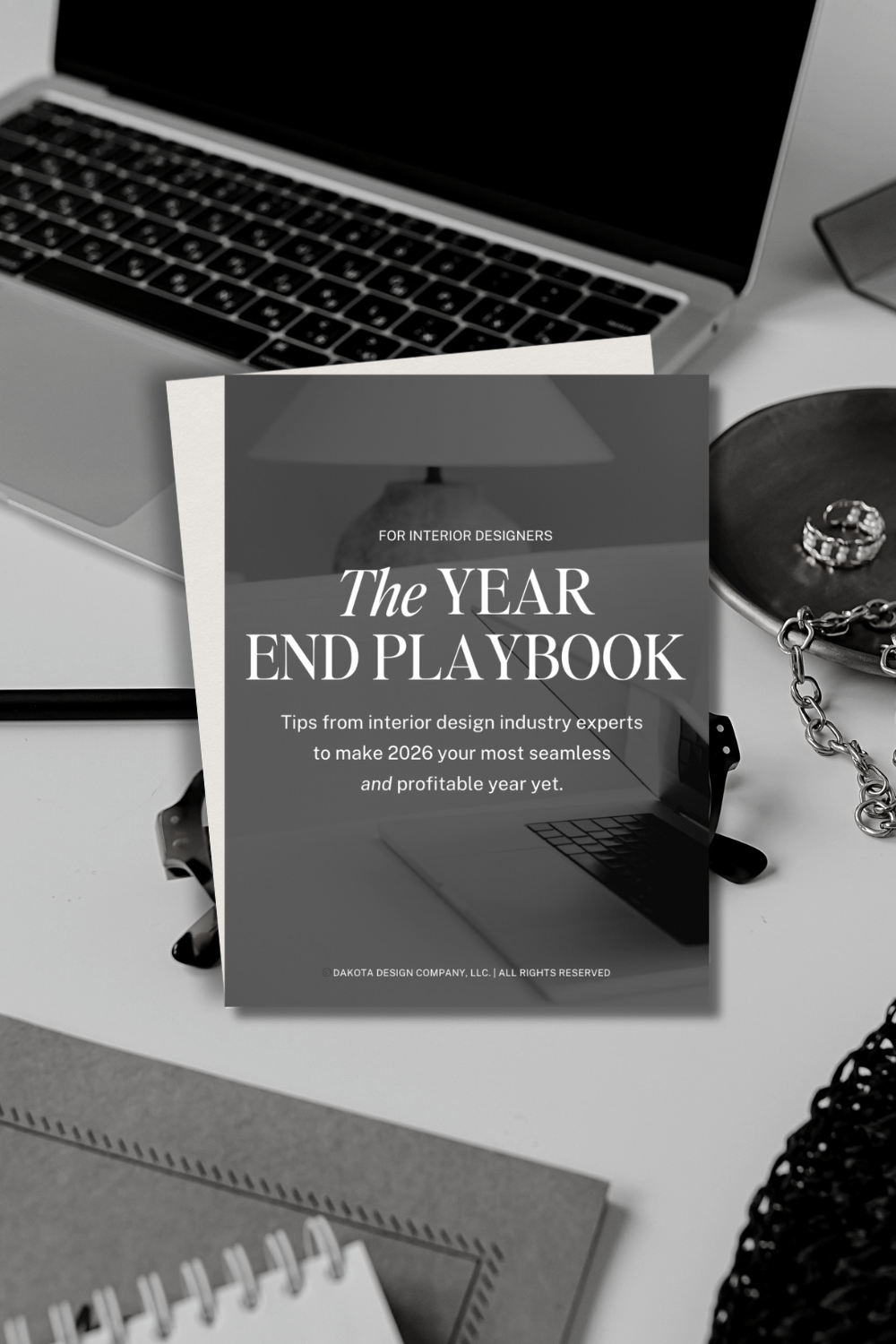
Each year, we compile insights and tips from interior design industry experts to help make the year ahead more seamless and profitable. We gather these contributions into our annual playbook, and in this blog, we’re sharing one individual expert insight pulled directly from that resource.
These are tips from an operations consultant specializing in client experience and process design for interior designers, with experience supporting 100+ firms across the U.S. and Canada.
Every year, I talk with hundreds of interior designers across the U.S. and Canada through calls, launches, live trainings, our programs, email, and my private consulting work.
And while every business has its own challenges regardless of how successful it is, the same themes have surfaced again and again this year.
If I were running your interior design business right now, these are the four shifts I’d be paying the closest attention to and how I’d respond.
Shift #1. A wave of low-quality, penny-pinching leads.
Inquiries from people who admire your aesthetic but don’t value your process are a waste of time. Yet there they are, in your inbox. 👋👋
These people want to reuse everything they already own, eliminate parts of your process, or squeeze their full scope into a smaller price point. This is universal right now.
What’s really happening:
Your business model and marketing create the behavior you see. When messaging is unclear, too broad, or too “we do everything for everyone at any time because we’re SoOoOoOoOOOOO flexible”, you are essentially rolling out the red carpet for those red-flag clients.
What to do:
Have a point of view. (Meaning, share your opinion through YOUR specific and unique perspective)
Share your point of view throughout your marketing.
Tighten your services (and FTL, your skills are not the service). Floor plans, renderings, sourcing, FFE, etc. Those are tools, not the transformation. Clients pay $$$ for incredible outcomes, great communication, and seamless experiences, not for how much you can cram into a service.
Stay true to your process and your boundaries. ⬅️ these are both in place to keep you profitable and happy.
When potential clients understand exactly what you do, who you do it for, and at what level, bad-fit leads and red-flag clients are instantly repelled.
Shift #2. Sales cycles are longer because clients feel less safe.
Great-fit clients are still out there. They’re just taking wayyyyy longer to commit than they did in the old days. They’re afraid of choosing wrong, making a mistake with their largest asset, or being disappointed or duped.
What’s really happening:
We’re in a trust recession, and people can’t tell the difference between what’s real and what’s fake - meaning they can’t tell whether you’re as good as you say you are or you’re just really good at sales and using AI renderings as your portfolio.
Long sales cycles reflect uncertainty, not a lack of desire.
What to do:
Create a thorough and clear communication plan from the initial inquiry all through the proposal process and to onboarding. You’ll want to make sure these emails build trust, highlight your experience, let them know YOU WANT their project (THIS!!!), and assure them, “You’re in good hands. We’ll make this as easy and as enjoyable for you as possible.”
Our Waitlist Emails are GREAT for this and can be used to nurture during the the sales cycle OR during the onboarding process.

Shift #3. The rise of hybrid services.
You’re probably hearing more and more variations of:
“I want help, but not all of it.”
“I want your design, but I want to source myself.”
“I want you to just tell me what to do.”
This isn’t stubbornness. It’s fear. People want to feel involved because involvement feels safer right.
What’s really happening:
Clients are trying to reduce risk by controlling more pieces of the process, which often leaves designers in no-man’s land: responsible for the outcome but not able to control it.
What to do:
If you want to offer a hybrid service, it must be structured, contained, and non-negotiable.
Clear deliverables, clear boundaries, clear responsibilities, clear timelines.
You design; they execute. Without guardrails, hybrid projects quickly expand into messy, unpaid project management and painful scope creep every.single.time.
Shift #4. Pricing optics are under a microscope.
Clients are analyzing line items like never before. They’re not questioning your value (most probably don’t fully understand it anyway). They’re questioning what they think they’re paying for.
What’s really happening:
Itemized pricing triggers fear. It makes people think they’ll be constantly pulling out their checkbooks and that the bills will add up to something even bigger than what you’re presenting. In other words, they don’t trust that “the price is the price”.
People compare, calculate, and fixate on the wrong details when you show them a laundry list of prices and things they’ll have to pay for.
But they don’t question what feels whole and necessary for their desired outcome. They question what feels piecemeal and optional.
What to do:
Design a menu of services you love that will be PERFECT for your ideal clients and then present pricing as a complete experience NOT as “phase 1 is $X, phase 2 is $Y, phase 3 is $Z, phase 4 is $XYZ, etc.”
Present pricing in context with your design process and the experience they’ll have with your firm.
In our signature program, The Designed to Scale® Method, we help designers establish a menu of profitable services they love and an elevated way to deliver them to dream clients. Details here.
My big-picture take for interior designers in 2026
Don’t add more. Don’t roll out extra services. And please don’t discount your prices.
Here’s what to focus your energy on:
Getting crystal clear on your process so you can communicate it with confidence
Pricing based on historical project data and results
Creating a client journey that builds emotional safety at every step
There’s nothing “wrong” with your business. The market changed and clients are nervous. That’s all.
So stay steady. Communicate clearly (and often). Show clients you know exactly how much their project will cost, how long it will take, and how you’ll keep their project on track. And if you need help with any of these things, check out our signature program, The Designed to Scale® Method.