The Design Brief® | American Modernism (Mid-Century Modern Furniture and Architecture)

©️ Dakota Design Company 2017-2026 | All rights reserved. This content may not be reproduced, distributed, or used without permission.
WRITTEN BY DR. GLORIA for DAKOTA DESIGN COMPANY
In previous posts, we covered a variety of historical periods in architecture, interiors, and furniture design:
The last post listed above covered furniture styles that were strictly American, but it did not include a critical period: the architectural and furniture design movement that took place from about 1930 to 1970, called Modernism.
The Modernist movement included innovations in art as well as architecture and furniture, including abstract expressionism, pop art, and surrealism. But that is a topic for a different post. And music of the time also took innovative turns in the 20th century as well, including Blues, Jazz, and Rock and Roll. But here, we will explore what transpired in architecture and furniture design during this period.
Let me also clarify some terminology. I sometimes hear people say that current designs look really modern. That is a misuse of the term. Modern design is really of that period of about 1930 to 1970, the topic of this post. A more appropriate term for designs being produced at the current time would be contemporary.
By the early to mid-20th century, the American landscape was undergoing a profound transformation. At the beginning of the century, most people didn’t have indoor plumbing or electricity in their homes, and transportation relied on horses and buggies. Just a few decades later, in 1969, the United States sent astronauts to the moon.
In the 1950’s, the convergence of a booming post-war economy and a surge in birthrates fueled a rush toward homeownership, effectively giving rise to the modern suburb. This era of suburbanization was further accelerated by the mass production of automobiles and a newly expanded network of highways. In 1950, only about 9% of American homes had a TV; by 1959, that number had soared to nearly 90%.
Simultaneously, the social fabric was shifting: women were entering the workforce in record numbers, and the pace of daily life quickened as new technologies reshaped the home and the office. Following decisive victories in both World Wars, the United States emerged as a global superpower, fostering a national sense of security and supremacy. Together, these forces acted as a catalyst for a radical evolution in American lifestyle and material culture.
So it was no wonder that the architectural style of the times took on a distinctly new flavor. Unlike the previous styles of Beaux-Arts, Art Nouveau, and Victorian—all of which were ornate and featured many embellishments—modern architecture was quite simplistic. Ludwig Mies van der Rohe famously said “Less is More,” meaning that stark simplicity is better than elaborate ornamentation. Modernists embraced minimalism and clean lines.
International Style Buildings
In the early 20th century, construction methodology shifted from masonry (stone, brick, and mortar) to buildings with steel skeletons. Masonry buildings had to have thick walls to hold the weight of the upper stories, and overall building height was limited. Thanks to much more lightweight steel construction and the development of elevators, commercial building construction rose to new heights during the Modern period. These buildings were said to be in the “International Style,” as there was no indication of context or locale within their design.
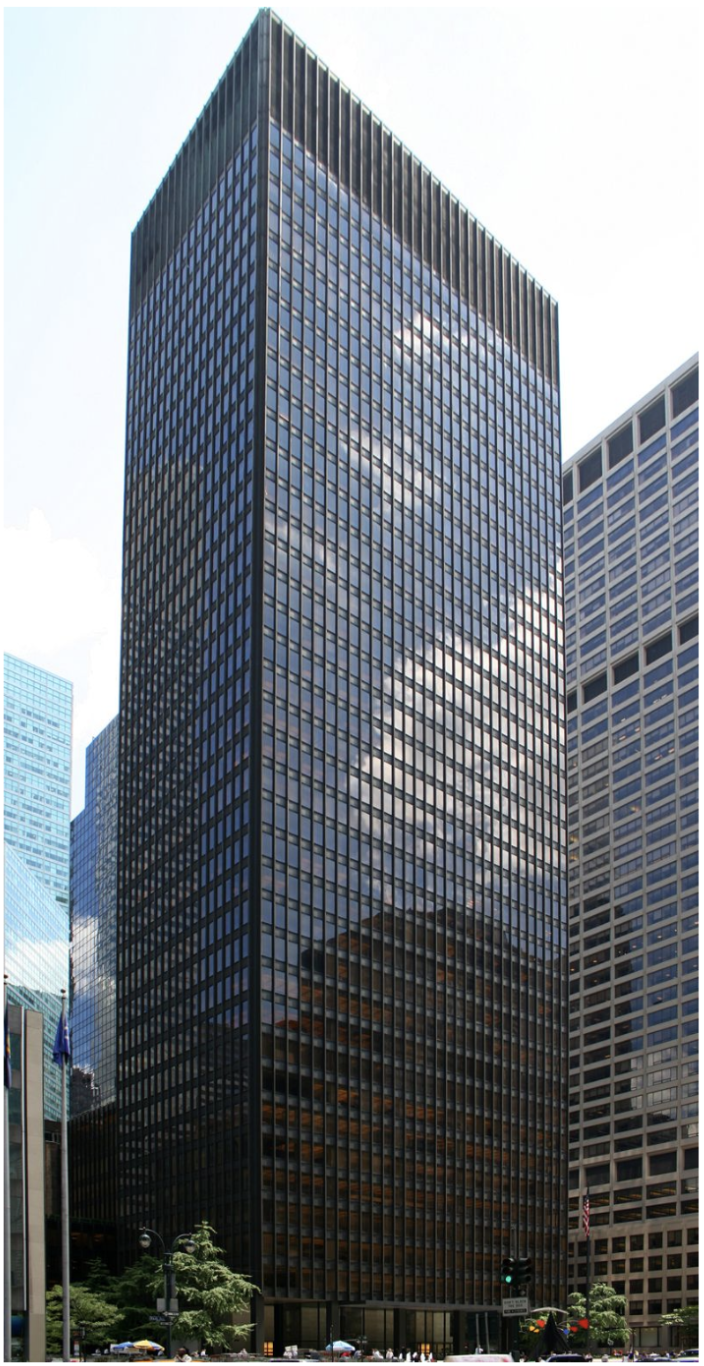
International Style buildings were honest to their purpose and their materials. They had no decoration; instead, they allowed the materials to BE the building design: steel, concrete, and glass. Buildings were monolithic geometric forms with flat roofs and glass curtain walls, devoid of ornamentation.
Ludwig Mies van der Rohe, who emigrated from Germany to Chicago in 1937, was a leading architect of this period and style. One of his most well-known buildings was the Seagram Building in New York, built in 1958. The steel skeleton of the building was celebrated, not hidden.
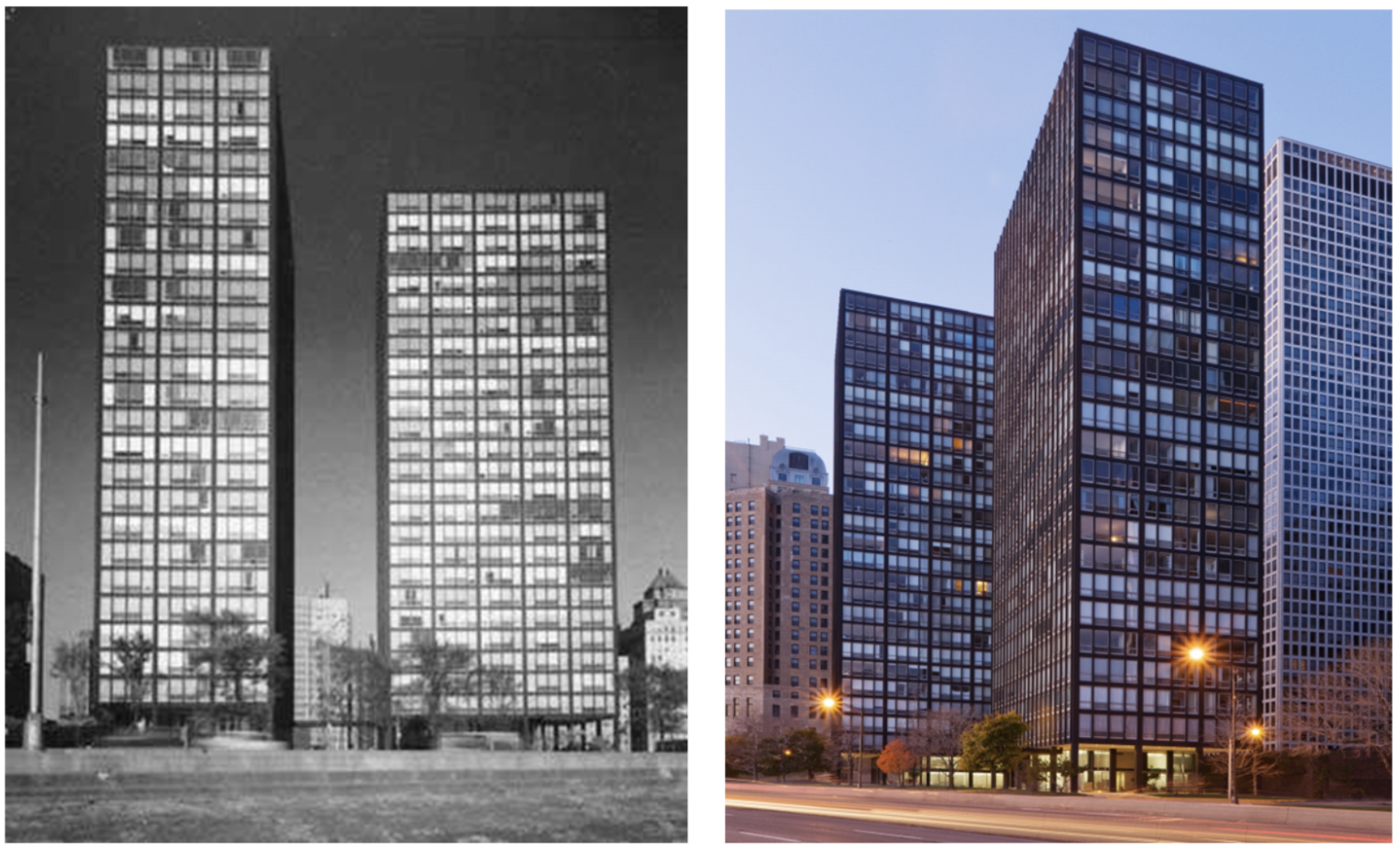
Most of his buildings were in the Chicago area, including Lake Shore Drive Apartments, completed in 1958, shown below, then and now. The structural steel (the bones of the building) supported the structural load, allowing the exterior (the skin) to be made almost entirely of glass. This was an entirely new aesthetic for architecture.
Modernist Home Design
Mies van der Rohe also designed this single-family home outside of Chicago, for a client in 1951: The Farnsworth House. Again, the materials—steel, concrete, and glass—are showcased as central elements of the aesthetic.

Learn more about Ludwig Mies van der Rohe in this post.
Architect and designer Charles Eames, and his wife Ray Eames, were very influential designers at the time, mostly of furniture. But the home they designed for themselves (built in 1949) is also a great example of the Modernist style, although one can see from the interior image below that they were not really minimalists.

Joseph Eichler was another California house designer who really developed what we consider the quintessential Mid-Century Modern house style. He built these homes during the 1950s through 1970s. They featured low-slope roofs, exposed wood, large windows, open floor plans, and an organic connection to the landscape. The interiors were open and light-filled.

Modern Furniture Design - Charles and Ray Eames
Husband-and-wife designers Charles and Ray Eames also designed some chairs that have remained quintessential mid-century styles. They had experimented with bending plywood during World War II to create an effective leg splint that would allow servicemen to be taken off the battlefield without further injury from the splints themselves, which were previously heavy, unyielding metal contraptions.
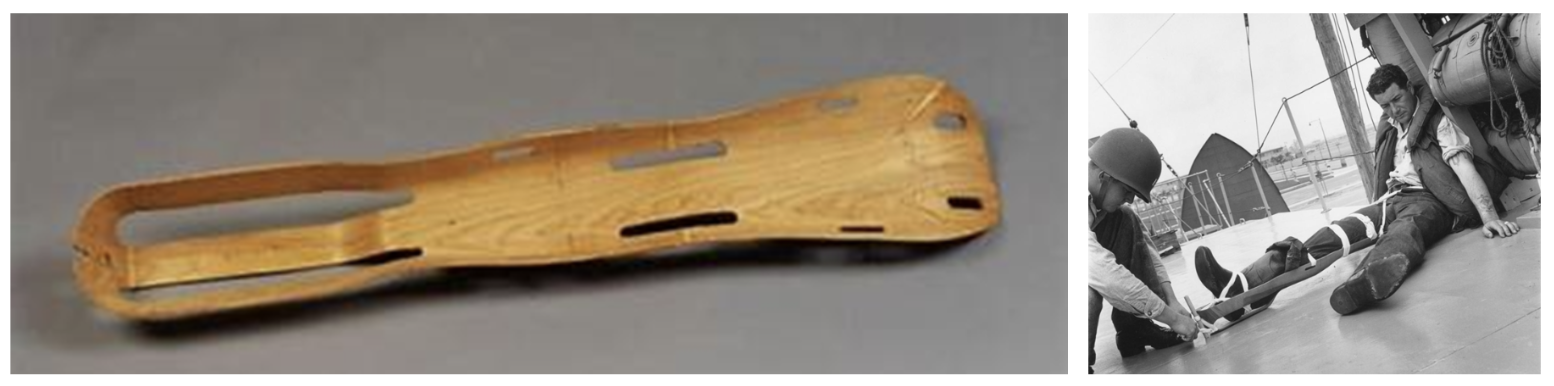
After the war, the Eameses used the wood-bending techniques they had developed to design molded chairs that remain very popular today.

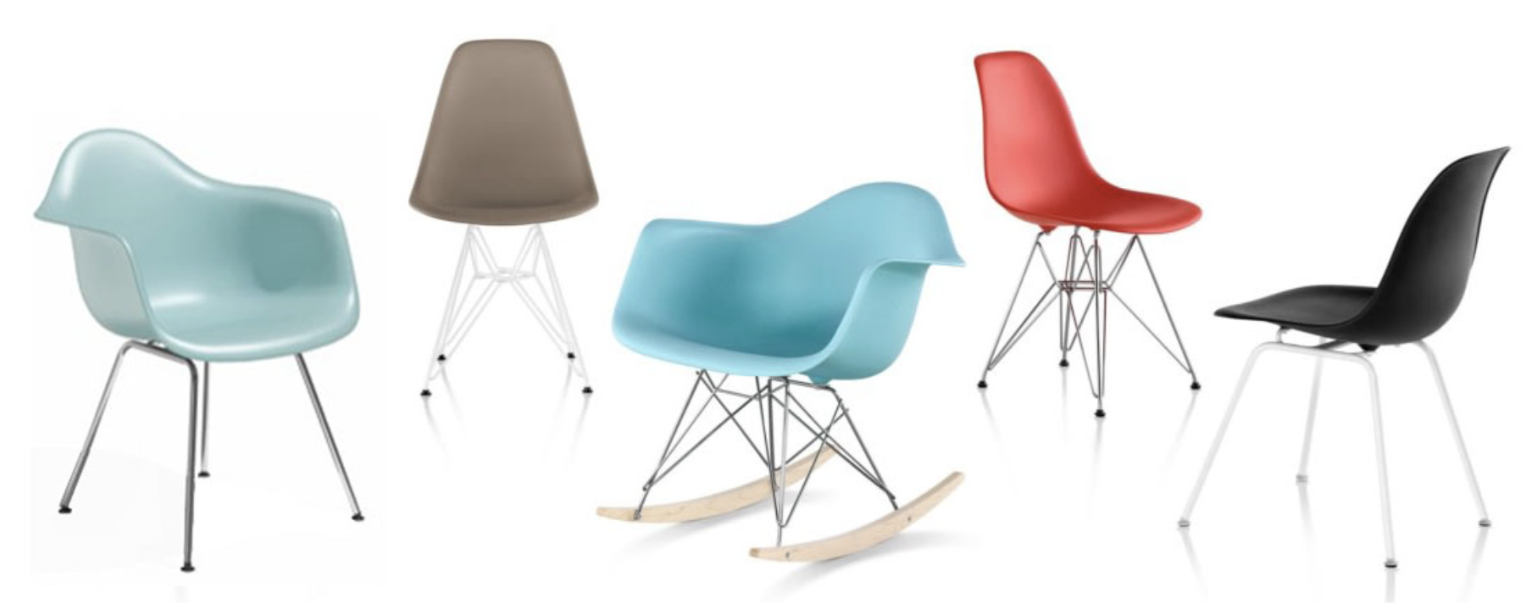
They also experimented with molding plastic and fiberglass to develop these well-known molded-plastic chairs with a variety of base types.
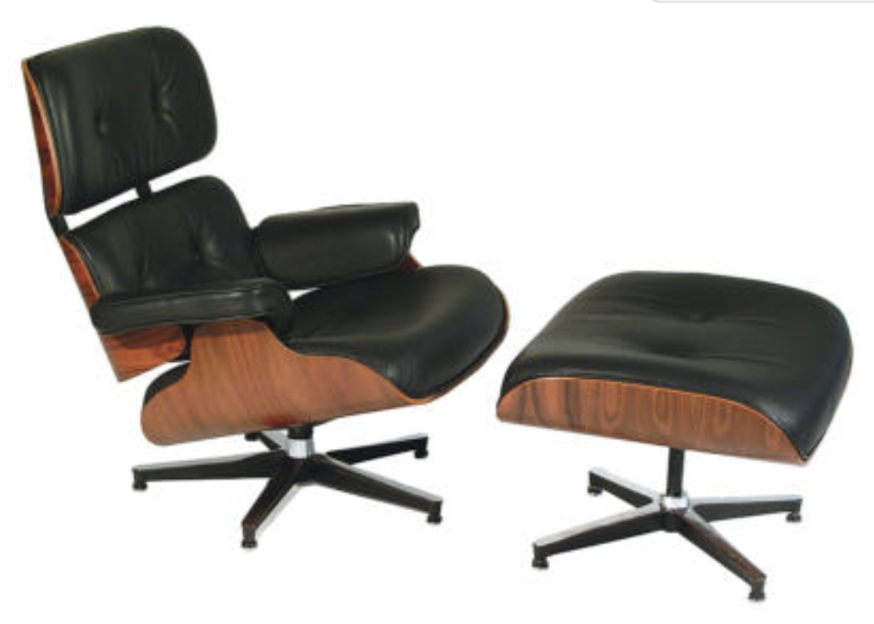
Perhaps their most well-known chair design, still an icon of Modern design, is the one simply known as the Eames lounge chair (1956). It includes a molded plywood base and leather upholstery. Charles Eames imagined it as having “the warm, receptive look of a well-used first baseman’s mitt.”
The Modernist movement was in large part, about experimentation with shape and form. Furniture designers had newly available materials at their disposal: tubular steel, polyurethane foam, and a variety of plastics that allowed them to innovate. Architects also strove for innovative forms that captured the spirit of rapidly evolving societal transformations.

The New Frontier of Airport Design - Eero Saarinen
Eero Saarinen designed the Dulles Airport terminal and the TWA Flight Center at John F. Kennedy Airport to capture the fluid motion of emerging jet travel.

Saarinen also designed some very memorable furniture designs, and wanted a departure from the traditional four-legged furniture, which he called a “slum of legs.” His goal with the Tulip Chair and Table (1955-1956) was to achieve a unified, organic shape in which the base and top appear as one integrated form, like a flower and a stem.

Saarinen designed the Womb Chair in 1948, featuring a silhouette that allowed people to curl up and feel secure and comfortable. It featured a molded fiberglass shell, removable foam cushions for extra padding, tubular steel legs, and an optional matching ottoman.

Case Goods Furniture of the Modernist Period
A leading manufacturer of case goods and occasional pieces of the period was Heywood-Wakefield, in Massachusetts. They produced most pieces in the blonde color of solid Yellow Birch, which became hugely popular at the time.

Today, antique Heywood-Wakefield pieces are highly sought after for their distinctive wheat-toned finish and aerodynamic, sculptural curves, which were hallmarks of mid-century modern style.
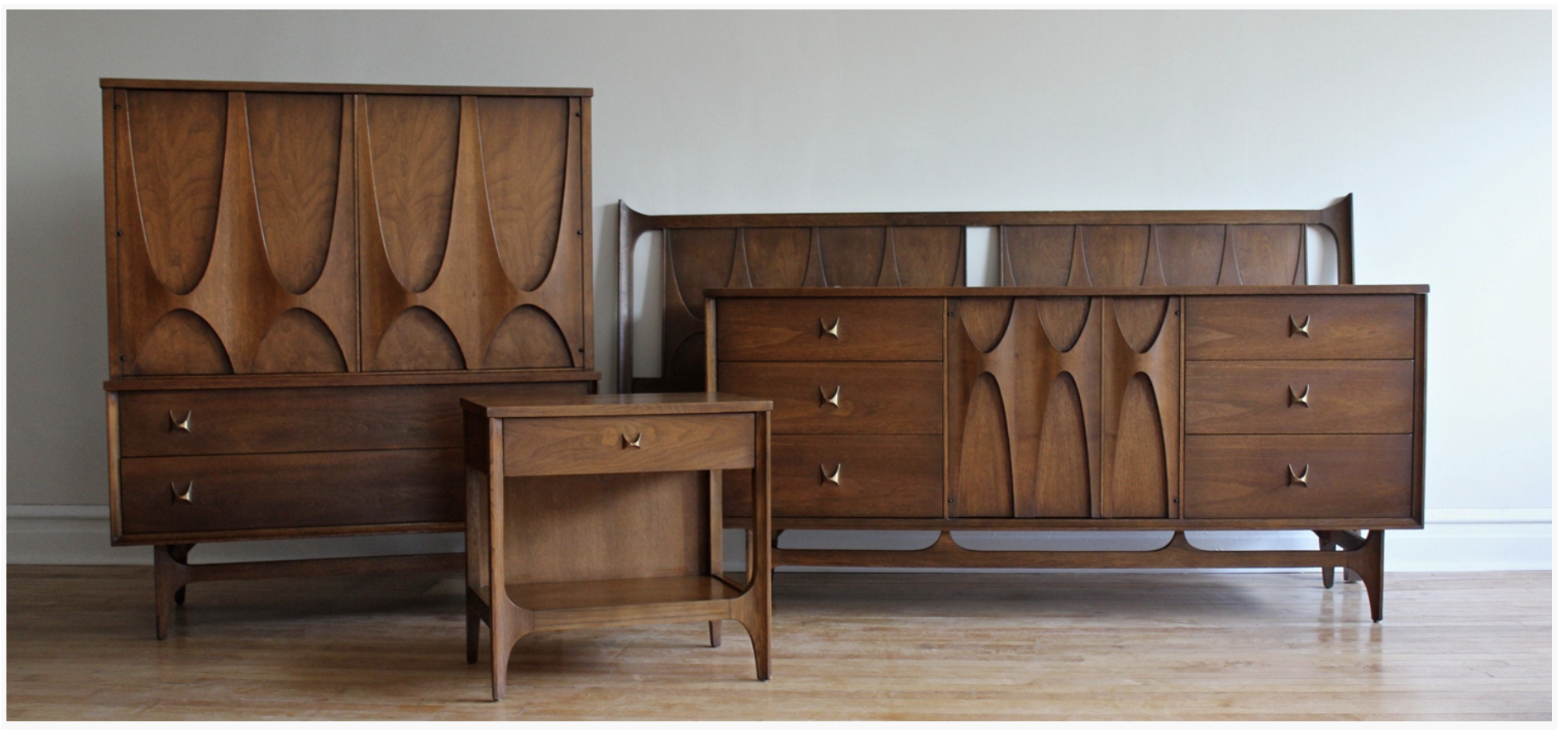
Other wood species that defined the mid-century aesthetic are teak and walnut. Teak is a very dense wood with warm tones and a distinctive, tight grain.

Walnut is a distinctively chocolatey brown color, which became very popular for its visual warmth. Its tones accentuated the distinctive styling of mid-century case goods.
Colors, Lighting, and Textile Design
Mid-century styling was very distinctive, and practically shouted “the future is here!”
Color use departed from muted tones of the past towards saturated “Atomic” colors, such as chartreuse, burnt orange, avocado, harvest gold, forest brown, turquoise, flamingo pink, and poppy red.

This was the period of space exploration, and the quest to put a man on the moon (which occurred July 1969), so motifs in textile patterns reflected the constellations, planets, and satellites.

Popular light fixtures also had a “space-age” look.

It is important to remember what an innovative time the middle of the 20th century was: societal changes were happening at a rapid pace. Wartime technological advancements introduced the use of molded plywood, fiberglass, and steel—materials that allowed for fluid shapes previously impossible to manufacture.
Ultimately, Mid-Century Modernism was the visual language of a world looking forward. By marrying industrial efficiency with human-centric comfort, designers responded to a booming middle class that craved a fresh, functional, and sophisticated identity for the modern home. It is not surprising that these styles are currently experiencing a massive resurgence in popularity. The clean lines and organic curves really resonate with a new generation of homeowners seeking a timeless, retro-inspired aesthetic.

Want The Design Brief® delivered straight to your inbox?
If you liked this email, be sure to sign up for The Design Brief®, our complimentary publication that gives you bite-sized lessons on all the technical interior design topics you didn’t learn (or forgot) from design school—straight from our resident tenured interior design professor!