The Design Brief® | The Wood Series: Exploring Some of the Most Popular Wood Species for Flooring and Cabinetry

©️ Dakota Design Company 2017-2026 | All rights reserved. This content may not be reproduced, distributed, or used without permission.
WRITTEN BY DR. GLORIA for DAKOTA DESIGN COMPANY
This article provides an overview of the most commonly used wood species used for flooring and cabinetry, including oak, maple, cherry, poplar, and walnut. With all the wood options available on the market, it is important for interior designers to be well-informed and knowledgeable!
The Different Cuts of Wood
First, let’s cover some basics about lumber processing. When a piece of timber arrives at a sawmill, it can be cut into wood planks in a few different ways, which will affect the appearance of the wood grain.

Plain sawing is the simplest way to process a piece of timber into wood planks. It is also the most material-efficient, with the least amount of waste. Therefore, it is the lowest-cost cutting method, resulting in the lowest-cost lumber.
When plain sawn, the strong wood grain of some wood species, particularly oak, results in what is called cathedraling—where the grain forms a series of nested arches, like the vaulted ceilings and pointed arches of a Gothic cathedral.

Quarter-sawn lumber results in a very straight grain and, and flecking, or interesting random patterning that is highly prized. Quarter-sawn lumber has more dimensional stability than plain-sawn wood, so is less likely to cup or warp. But the cutting technique is more complicated and there is more waste, so quarter-sawn wood is more costly compared to plain-sawn.
Flecking refers to a unique grain pattern that resembles small flecks or stripes. This effect is most prominent in species like oak. The flecking occurs because the wood is cut in a way that maximizes the visibility of the medullary rays.

If the flecking of quarter-sawn lumber is not desired, rift-sawn wood also has a very regular, tight-grained appearance. And, like quarter-sawn, rift-sawn lumber is more stable than plain-sawn. But again, the cutting method is more complex, with a lower yield than plain sawing, so cost is added to the finished material. And, with both quarter-sawing and rift-sawing, due to the way the log is cut—perpendicular to the outside edge—it is impossible to achieve wide boards.
The sawing method will have a distinct effect on the appearance of the finished wood: plain-sawn often with cathedraling, quarter-sawn often with flecking, and rift sawn with the most regular pattern typically.

The Janka Hardness Rating
This method is used to determine and compare the relative hardness of various wood species used for flooring, cabinetry, and millwork. The harder a wood, the less prone it will be to dents and dings during use. Hardness is just one quality to consider when choosing a wood species, in addition to texture, grain, color, and cost.
The test measures the amount of force and pressure required to drive a 44/100th diameter steel ball into a piece of wood, until the ball is embedded into the wood half of its diameter. The more force required to drive the steel ball to its halfway point, the higher the Janka rating, and the harder the wood.

Some Janka ratings of commonly used wood species are:
Hickory - 1820
Sugar Maple - 1450
White Oak - 1360
Ash - 1320
Red Oak - 1290
Walnut - 1010
Cherry - 950
Douglas Fir - 720
Poplar - 540
Ponderosa Pine - 460
Pine is considered a soft wood, cherry a medium hardwood, and Hickory a hard hardwood.
So now, let’s look at some specific wood varieties.

Oak - What’s Old is New Again
Oak is both the unsightly remnant of years gone by (think the orange-toned, highly grained cabinets of the 1980s) and the most stunning wood material used in high-end homes today! How could the same wood species be at both ends of the spectrum? The difference is in the subspecies, the cut, and the stain.
Here are red oak cabinets and flooring of yesteryear:

And here are some beautiful current-day applications of white oak:

Why is the look of the dated red oak, and the stunningly beautiful white oak so different??? Several reasons.
Red Oak Characteristics
Red oak has been one of the most widely used hardwoods nationwide for decades. In its natural state, it features a warm, distinctively orange-red-brown coloration balanced by a coarse texture and a prominent, open grain pattern.
Because red oak is a highly abundant, fast-growing species, raw lumber is naturally plentiful. And because it is typically processed as plain sawn—the most cost-effective way to manufacture lumber—its cost remains low. The combination of an abundant species and efficient milling makes red oak an incredibly budget-friendly option for flooring and cabinetry.
When plain sawn, the strong wood grain of red oak results in strong cathedraling, where the wood grain forms a series of distinctive arches.

White Oak Characteristics
White oak is harder and higher on the Janka scale than red oak (1360 compared to 1290). It features a tighter, more uniform grain with smaller pores. White oak is a denser wood with a finer grain pattern, with shorter rays—or dark grain streaks—compared to red oak, meaning that it will not have the same cathedraling appearance. See white oak (below left) next to red oak (below right).

And, white oak, as is currently popular, is often quarter-sawn or rift-sawn. That results in a different grain pattern, but narrower boards. White oak is generally more expensive than red oak due to its slower growth rate and higher demand.

Historical Perspectives on Oak
Over time, different woods have fluctuated in popularity, both due to their aesthetic and their availability. While a core variety of hardwoods—such as oak, cherry, mahogany, maple, and walnut—has been utilized across centuries, certain eras became completely defined by a single, predominant species.
The Arts and Crafts movement, emerging in Britain and the United States from about 1880 to 1920, arose as a direct rebellion against the ornate, factory-made pieces of the Victorian era. Led by designers like William Morris and Gustav Stickley, the movement championed a return to a simplistic, naturalistic, and hand-made quality in both architecture and furniture. Oak was their wood of choice, as the strong wood grain exemplified the honest, rugged character of the material itself.

Maple, as in Sugar Maple
There are several sub-species of Maple trees. The most commonly used one is Sugar Maple, also called Hard Maple. Sugar maple is extremely hard, with a Janka rating of 1450. Other maple varieties are much softer. Its natural color is a pale to medium yellow, and has a very fine texture with an extremely even grain.

Maple takes stains very well, and can be stained to replicate more costly wood species, like cherry or walnut.

Sugar maple is very commonly used for cabinets and flooring. It also has excellent wear resistance and is quite hard, so is used for gymnasium floors.

Cherry, aka Fruitwood
The most common varieties of cherry for use in flooring, cabinetry, or furniture are American, or Black cherry, and Brazilian cherry. Brazilian cherry, from Central and South America, is a much harder, denser, and more expensive material. Compare that American (Black) cherry is 950 on the Janka scale, a medium hardness, and Brazilian cherry is 2350, very hard.
All cherry, when freshly cut, has a light pinkish tone that darkens to a deep reddish-brown tone with age. To emulate the natural darkening over time, new cherry wood is often stained to a reddish-brown tone.

Cherry can also have some cathedraling to its grain, but is a much more closed, even, and fine grain compared to oak. It has a satin smooth finish. American (black) cherry is more expensive than oak or maple, and Brazilian cherry is significantly more expensive than the American variety, both because of its denser characteristics and because it has to be imported.
Historical Perspectives on Cherry
Cherry has been used for furniture for centuries. It was the predominant wood used for furniture during the Queen Anne period, which took place in England and the United States from about 1700 to 1750. Cherry was favored for its fine grain and rich color. After the Queen Anne period, cherry continued to be used in American furniture, especially in the Federal style. Its popularity waned in the 1800s as other woods like oak and mahogany gained popularity. Intricate carvings, delicate inlays, and the cabriolet (s-curved) leg showcased the beauty of cherry in furniture.

Cherry was again very popular in the 1990s and 2000s for both flooring and cabinetry. In reality, some of these applications may have been cherry-stained maple.

Poplar, Often Known as “Paint Grade” Wood
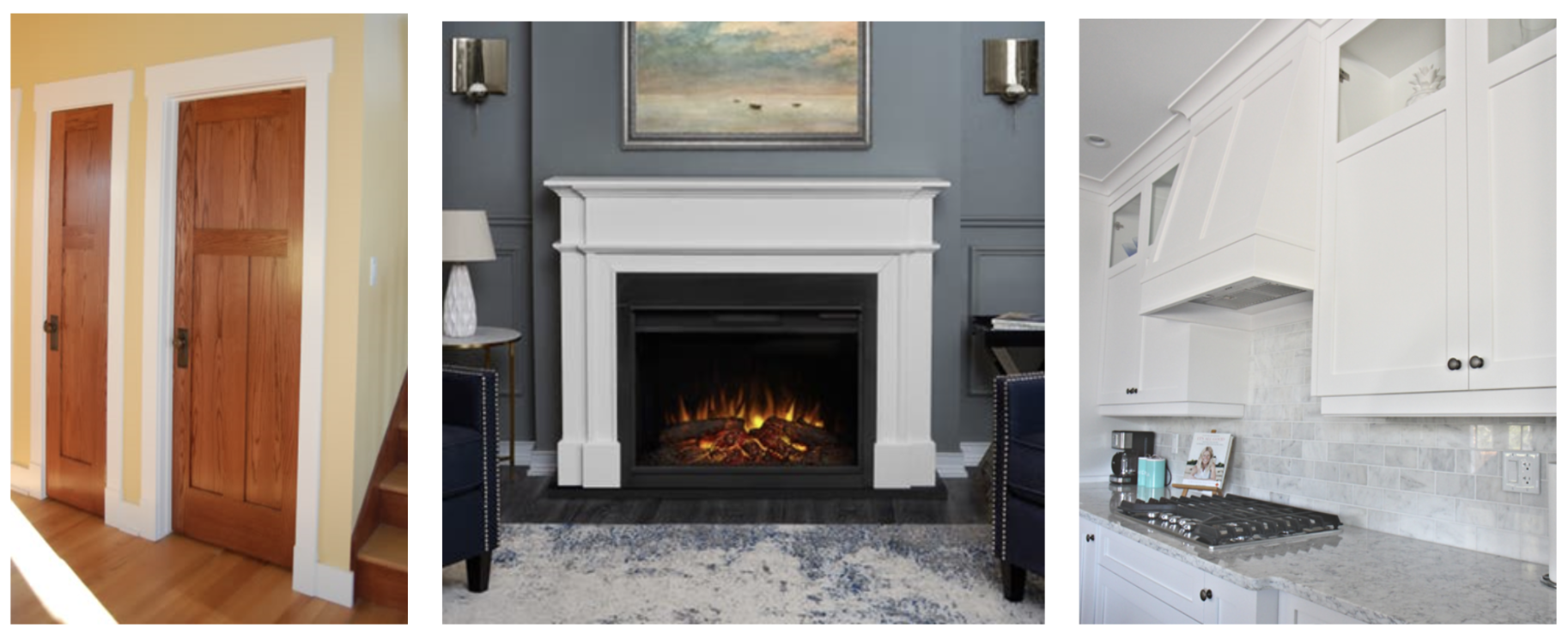
Poplar is one of the most common utility hardwoods, prized for its straight grain, uniform texture, and lightweight nature. It is fairly soft, with a Janka rating of 540. Because it's fine, even surface takes paint exceptionally well and yields a highly durable surface, there is rarely a need to opt for a more expensive wood species when a painted finish is desired. This makes it a highly budget-friendly alternative to premium hardwoods.
Furthermore, poplar boasts low shrinkage and expansion rates, significantly reducing the risk of the paint cracking over time. In its natural, unstained state, it has a clean, light appearance with white or creamy yellow hues.
The images below show poplar with varnish and with paint.

Because it takes paint so well, poplar is often used for painted millwork, doors, and cabinets.
Knotty Alder - the Rustic Alternative
If a rustic aesthetic is desired, perhaps for a lake home or mountain cabin, knotty alder is a great option for flooring or cabinetry because of its knots. In the world of lumber, knots are not flaws—they are history. A knot forms where a living branch once grew out of the main tree trunk. As the tree grows larger, the trunk naturally wraps around the base of the branch, leaving behind a dark, dense, circular cross-section within the wood grain. These knots are the very definition of a "rustic" aesthetic because they celebrate nature’s beautiful imperfections. They tell a story of the forest, instantly bringing a sense of warmth, rugged charm, and the great outdoors into an interior space.
This smooth hardwood features a beautiful, straight grain pattern and warm coloring, ranging from a light honey tone to a rich, reddish-brown. What truly sets this wood apart from other species, however, is its striking visual texture and irregular knotting. It is a medium hardwood with a Janka rating of 590.

Hickory – If Variation is What You Want
Hickory is a true hardwood, with a Janka rating of 1820. This extreme density makes it uniquely suited for flooring that will receive hard wear and high traffic. A hickory floor can easily handle the daily chaos of active families, heavy pets, dropped cast-iron pans, and high-heeled shoes without showing a scratch.
Hickory’s other very notable characteristic is its wide variation in color and tone. Its high-contrast mix of creamy white sapwood (the outer layers of the tree) and deep, dark brown heartwood (the center) is quite striking. The bold variation means that a hickory floor will easily hide dust, dirt, and minor imperfections beautifully. When used in cabinetry, the distinctive two-toned coloring creates an organic or rustic aesthetic. Its bold variation means it might be best paired with simpler, calmer surrounding materials, such as simpler countertop colors.

Walnut - True, Chocolatey-Brown Wood
Walnut (specifically American Black Walnut) has a distinctive coloring, unlike many other woods. It is truly chocolatey brown in coloring, without the red undertones that many other wood species have. Unlike many hardwoods that require stains to look their best, American Black Walnut is beautifully brown in its natural, unvarnished state. There is perhaps no other wood with such a distinctly brown coloration.
It is a fairly hard wood with a Janka rating of 1010. Its grain has waves of color variation, and subtle cathedrating.

Historical Perspectives on Walnut
Walnut, with its distinctive coloring, has been favored throughout the centuries. During the Italian Renaissance, approximately 1300 - 1600, furniture underwent a massive transformation. It evolved from the heavy, purely utilitarian pieces of the Middle Ages into intricate, highly architectural statements of wealth, intellect, and status. Prior to this era, European furniture was primarily built from oak. But walnut, with its dense, fine, and uniform grain structure, is soft enough to carve smoothly but strong enough to hold crisp, razor-sharp edges, allowing Renaissance furniture makers to develop pieces with intricate carving and elaborate detailing.

Another notable era for walnut was the American Modernism movement—popularly known as mid-century modern—which took place from about 1940 to 1970. Walnut’s rich, smoky-brown undertones and dramatic dark striping perfectly complemented the organic curves and clean, geometric lines characterizing the era's innovative furniture. The species became the standard for iconic case goods and occasional pieces, allowing the natural, unadorned beauty of the wood grain to serve as the primary focus.

Read More Articles in Our Wood Series:

Want The Design Brief® delivered straight to your inbox?
If you liked this email, be sure to sign up for The Design Brief®, our complimentary publication that gives you bite-sized lessons on all the technical interior design topics you didn’t learn (or forgot) from design school—straight from our resident tenured interior design professor!