The Design Brief® | The Wood Series: Defining Specialty Applications of Wood

©️ Dakota Design Company 2017-2026 | All rights reserved. This content may not be reproduced, distributed, or used without permission.
WRITTEN BY DR. GLORIA for DAKOTA DESIGN COMPANY
When it comes to wood, there is simply a LOT that an interior designer needs to know! Of all materials used in interior spaces, wood dominates as the most widely used material. Unlike materials that might be used for a specific function (like stone for countertops or metal for fixtures), wood is used across nearly every interior component:
Framing: Most residential projects use wood as the primary framing material for walls, floors, ceilings, and staircases.
Architectural Features: Wood is the primary material used for doors, window and door casings, baseboards, and ceiling beams.
Cabinetry & Millwork: Wood, or wood by-products are used for kitchen, bath, and office cabinetry, built-in storage, shelving, and wall paneling.
Furniture: Solid wood or wood derivatives are used to construct tables, chairs, and occasional pieces
In separate posts, we have explored both common and exotic wood species used primarily for flooring and cabinetry. But there are other wood applications that designers must be familiar with. In this blog, we will define specialty applications of wood and wood by-products.
Nature’s Anomalies
Of course, only Mother Nature can create wood. There are estimated to be over 60,000 different tree species around the world, but only approximately 100 species of trees are commonly used for furniture, flooring, and cabinetry. Hardwoods like oak, maple, and cherry are preferred for their durability and aesthetics. Tropical hardwoods like teak and mahogany are valued for their beauty and resistance to decay. But Mother Nature does produce some interesting variations within these species that result in unusual figuring of wood; alterations of typical grain patterns caused by disturbances in the tree’s growth. These wood anomalies make very interesting furniture pieces!
Burl Wood
One particularly interesting wood irregularity is burl. Burl woods are bulbous outgrowths that form on the surface of a tree’s trunk, or close to the soil near the root of a tree, as a result of a deformation of the tree’s growth.
Just as we humans tend to develop bumps or growths that are considered irregular, burls can form as a result of stress on the tree, fungal infection, insect infestation, or simply a genetic disorder. But these conditions cause the wood to grow irregularly, creating some really interesting-looking grain patterns on the wood's surface.

When cut, these areas of burls have very interesting speckled, spotted, and wavy grain figuring. Many tree species—including Cherry, Elm, Oak, Walnut, Maple, and Ash—can develop burls. Because tree burls are a rare anomaly of nature, burled wood is quite expensive. But it results in stunning furniture pieces!

Historical Perspective on Burled Wood
Burl wood was favored during the Biedermeier period in Germany and Austria, which took place between 1815 and 1848. Napoleon Bonaparte had occupied parts of Germany, and when he was defeated at Waterloo in 1815, German culture emerged as more stable, secure, affluent, and comfortable, providing the perfect setting for the emergence of the Biedermeier style. The style prioritized function and the needs of a comfortable middle-class home.
The style focused on the natural beauty of wood grain rather than heavy ornamentation and was a precursor to modern functionalist design movements such as the Arts & Crafts movement, Art Deco, and mid-century modern design. Biedermeier furniture had a sense of bulkiness and masculinity, and burled wood was often used to showcase the inherent beauty of wood.

Birdseye Maple
Bird's eye is a type of figuring that occurs within several kinds of wood, most notably in hard maple. Birdseye Maple is a beautiful grain pattern that occurs naturally in a small percentage of Sugar Maple trees. It has a distinctive pattern resembling tiny, swirling eyes that disrupt the smooth lines of the grain.
Its wavy, circular appearance—that looks like eyes in the grain—is reminiscent of the appearance of burl wood. But Birdseye Maple is much more plentiful than the mutations causing burl, therefore, it is significantly more affordable than burled wood.

Crotch Mahogany
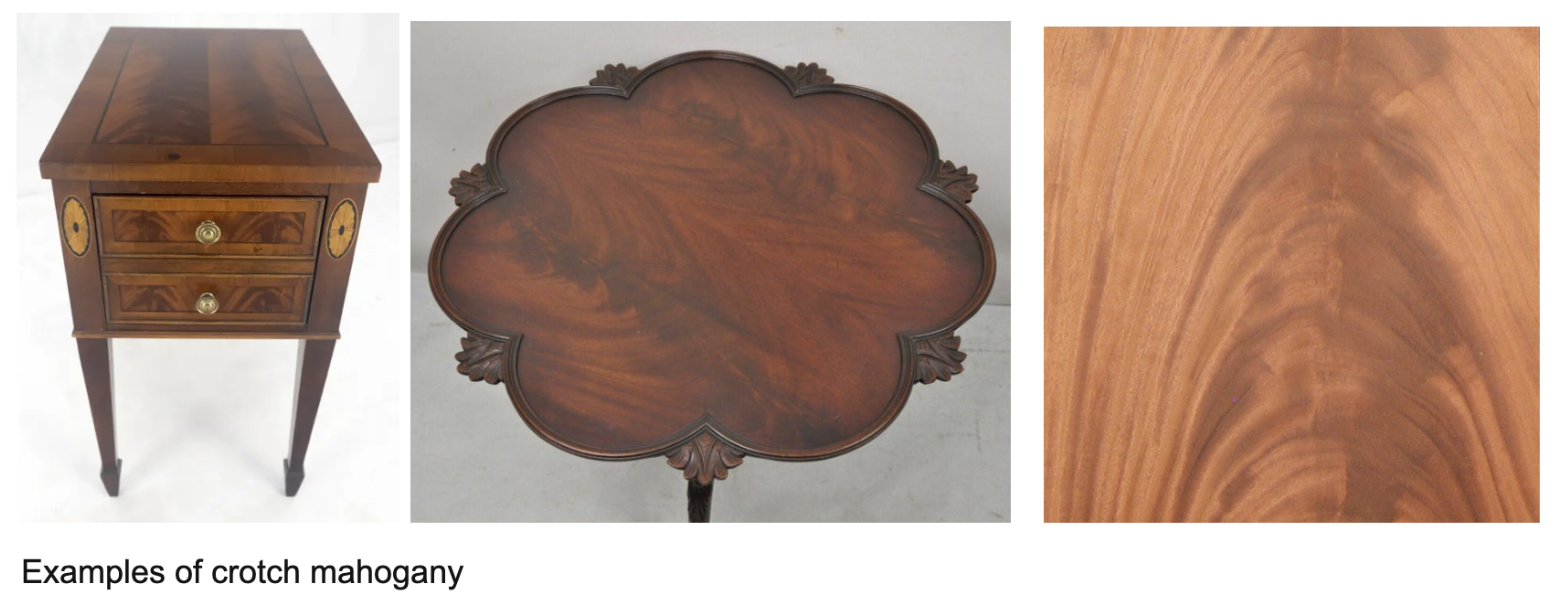
Another interesting wood grain trick, brought to us by Mother Nature, is crotch wood, harvested from the specific part of the tree at the junction of where a tree splits into branches. That particular location of the tree has a distinctive y-shaped grain pattern that is highly prized for its aesthetic impact and rarity. At the crotch of a tree branch, the tree’s growth is compressed, and the grain becomes highly figured.
Crotch wood is most often derived from Mahogany, but also from Walnut trees. Because it comes only from a specific portion of the tree, wood pieces are limited in size and availability—making it appropriate for veneers, inlays, and custom occasional pieces.
Wood Derivatives Sheetgoods
When considering the various uses and options for wood products, it is important to understand the different wood derivatives (such as plywood, MDF, and particleboard) used, which differ in nature from solid wood. Here, wood material is used, but not in the form of a single piece of wood cut from a tree. Such wood by-products are some of the most widely used materials in interior spaces.
There are several types of wood derivative sheet goods to consider: plywood, MDF, and particleboard. Then, equally important is to consider the finish material added to the wood derivative sheet good, from least expensive to most: melamine, TFL, HPL, and wood veneer
Plywood, MDF, and Particle (or Chip) Board Substrates

All three of these wood derivative sheet goods mimic the structural properties of solid wood but are much less prone to warping or splitting. With plywood, thin sheets of wood are stacked and glued together, with the grain of each layer running perpendicular (at a 90-degree angle) to the layer beneath it. This cross-graining provides incredible strength and stability.

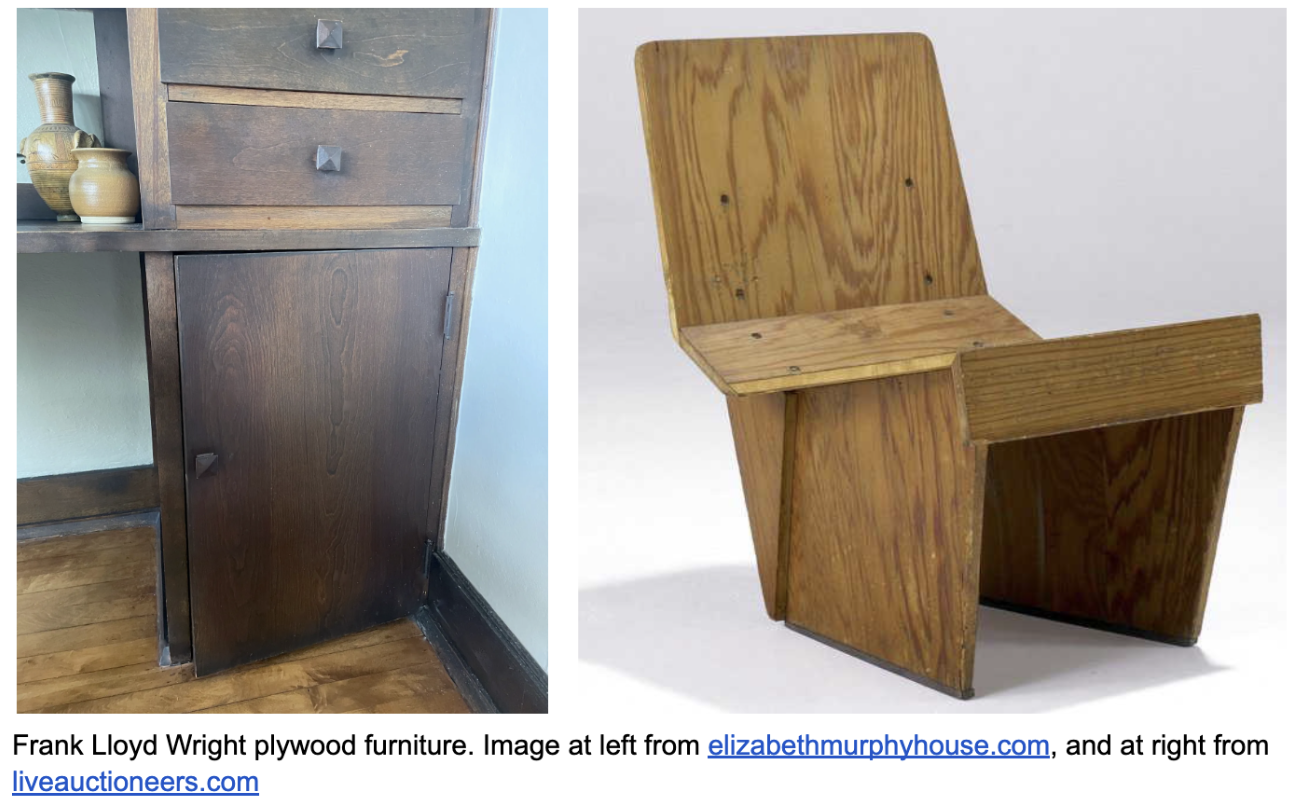
Plywood is used for subflooring, wall sheathing, and roof decking. It is typically used in construction applications where a different finish material will cover it. Plywood is not considered a material that is attractive enough to stand on its own, without the addition of a decorative layer. But, interestingly, architect Frank Lloyd Wright disagreed. In the latter half of his career, Wright often produced cabinetry and furniture out of stained plywood.
MDF, or medium-density fiberboard, is also a very strong material derived from wood. During the milling process, wood residuals (softwood or hardwood chips) are broken down into tiny, fine wood fibers, or wood pulp. These fibers are mixed with a synthetic resin binder and wax, then compressed under intense heat and pressure to create a dense, smooth panel.

MDF has a highly even surface. Because it has no visible wood grain, it is the industry standard material for smooth, painted finishes. And, because it is so dense, it holds paint extremely well. It can be easily shaped, carved, or routed, so can be made into decorative moldings, shelves, recessed panels, or cabinet doors. It does not expand and contract with changing environmental conditions, the way wood does. But, MDF is highly absorbent. If water penetrates it, it can swell and warp.

Particleboard, also known as chipboard, fiberboard, or strandboard, is made from post-manufacturing wood chips, combined with resin and compressed with heat and high pressure to form panels. Particleboard is cheaper than either plywood or MDF. Like MDF, particleboard will swell and warp when exposed to water.

The Decorative Layers Added to Wood Derivative Sheet Goods
In general, the much lower cost of wood derivative sheet goods has displaced solid wood from many cabinetry applications and has become the backbone of the vast majority of modular furniture and affordable interior cabinetry, far outpacing solid wood in terms of sheer volume of use. But different kinds of decorative finishes are added to these sheet goods, and it is important to understand the differences.
For instance, furniture sold at IKEA typically has an MDF or particleboard core with a very thin layer of decorative finish material added. This finish material can be a solid color, or can be fabricated with an image of real wood. Sometimes called melamine or LPL (low-pressure laminate), this material has one or two layers of kraft paper (that is a solid color or wood grain) pressed onto a particleboard or MDF core. This is a low-cost material that does not provide much durability.

A somewhat higher durability, but very similar-looking material is TFL, or thermally-fused laminate. This is the material typically used in closet systems and laundry room cabinetry. Again, it has a solid, or wood-look kraft paper fused to a particleboard or MDF core. But the decorative paper finish is fused to the wood-derivative substrate at a higher temperature, so this material offers greater longevity than melamine.

The other MDF- or fiberboard-based application to be aware of is HPL or high-pressure laminate. Here, think of laminate countertops, where a laminate material is glued to an MDF or fiberboard core. These laminate materials are produced by well-known manufacturers such as Formica and Wilsonart. The laminate material consists of a decorative paper layer that has a particular pattern or design printed on it, then a layer of resin is applied to the paper to create a strong bond, and a top coat is added to provide additional protection.
Requiring more materials and effort to manufacture, HPL is a more costly laminate option than HFL. But it is more durable, therefore HPL (high-pressure laminate) would be appropriate for horizontal, high-wearing surfaces like countertops and desktops, where long-term durability is critical. Lower-cost melamine and TFL surfaces do not offer high abrasion resistance would be more appropriate for vertical surfaces, such as ready-to-assemble furniture, closet components or closet shelving.
This entire sheet of HPL laminate, like the sample chips we are familiar with, is then glued onto MDF or fiberboard substrate to make a countertop or desktop assembly.

At the highest end of materials applied to wood derivative sheet goods is wood veneer. A wood veneer is a thin slice of actual natural wood—typically thinner than 3mm—that is then bonded to a wood derivative substrate (such as MDF, plywood, or particleboard).
Because the veneer is bonded to a core material, it does not suffer from the same expansion and contraction issues as solid wood. This makes it an ideal choice for large, flat surfaces like cabinet doors, table tops, and wall paneling.
It is a misconception that wood-veneer cabinetry or furniture is inexpensive or of lesser quality than solid-wood pieces. Veneers are used on many very high-end, expensive pieces.
Using wood veneers, instead of solid wood, has several benefits. Compared to solid wood, wood veneers over a wood-derivative substrate do not absorb moisture or humidity and do not warp or expand over time. Of course, using veneers versus solid wood pieces is a much more sustainable practice. A single log can produce thousands of square feet of veneer, whereas a solid wood board uses the entire thickness of the timber. Veneers allow designers to use rare or exotic wood species ethically and affordably. Also, wood veneers allow a variety of decorative applications, such as book-matching and inlays.
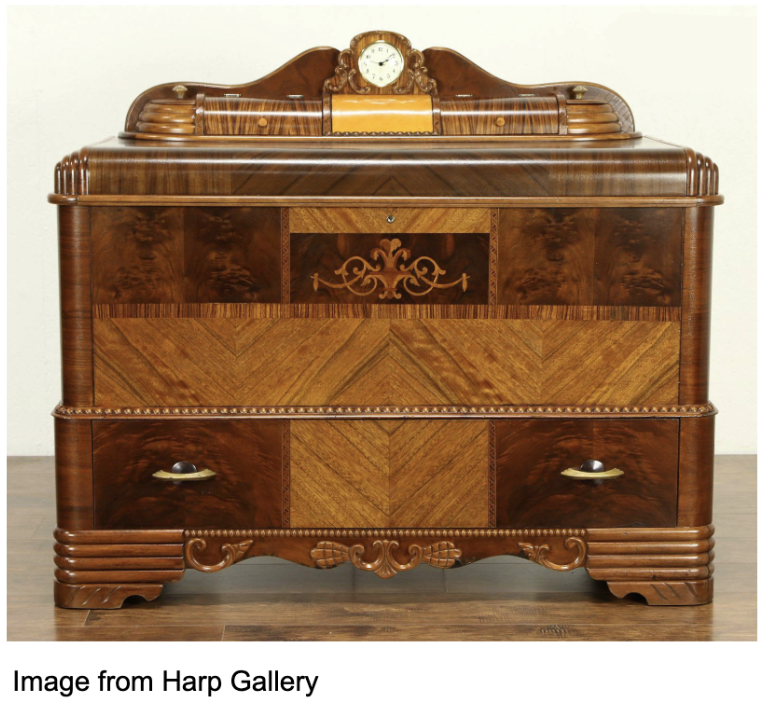
The real beauty of wood veneers, compared to wood-look laminates, of course, is that they have the authentic look and feel of actual, natural wood. But wood veneers, depending on the species, can be very costly.
Engineered Versus Solid Wood Flooring - An Important Distinction
When it comes to wood flooring, another important distinction applies. Understanding the fundamental differences between solid and engineered planks is essential for both performance and aesthetics.
Solid wood flooring is crafted from a single piece of 100% natural wood cut from a tree. Because it is a natural product, it is highly reactive to changes in humidity and temperature, making it prone to expansion and contraction. Consequently, solid wood is typically recommended for installation over wood subfloors on or above grade only. The standard installation method for solid planks is nailing or stapling to a plywood subfloor, though some wider planks may require a glue-assist method to minimize movement. In terms of dimensions, solid planks generally come in 3/4-inch thicknesses, with widths typically ranging from 2 1/4 inches (strip flooring) to 7 or 8 inches (plank flooring).
Engineered wood flooring, by contrast, is constructed with a real hardwood veneer top layer bonded to a core of multiple layers of plywood or particleboard. This cross-layered construction provides superior dimensional stability, allowing it to withstand moisture fluctuations better than solid wood. This makes engineered flooring a versatile choice suitable for installation in various environments, including below-grade basements and over concrete slabs.
Engineered wood is often installed as a floating floor using a click-lock mechanism, but it can also be glued down or stapled, depending on the manufacturer’s specifications. While thicknesses can vary significantly—often ranging from 3/8 inch to 5/8 inch—engineered planks can be manufactured in a wider variety of widths, sometimes reaching up to 10 inches or more, offering designers greater flexibility.
In general, solid wood flooring tends to be more expensive than engineered wood plank flooring, because it includes more prime material. But engineered wood requires more manufacturing effort, sometimes bringing its cost close to that of solid wood. The installation labor for solid wood can be higher and costlier, because it needs to be nailed down. When engineered wood is installed using a floating/click-lock method, the installation costs can be lower.
The key is that, once installed, it is very difficult to tell the difference between solid wood flooring and engineered wood flooring. The telltale sign is that, sometimes, walking on a floating engineered wood installation can result in a clicking, hollow sound.

While solid wood often requires a higher upfront investment, it is important to consider its long-term value and durability when assessing total cost. Because it consists entirely of hardwood, it can be sanded and refinished multiple times (often 5–10 times), allowing it to last 50–100 years. This provides excellent exceptional return on investment and high resale appeal.
With engineered wood flooring, the thickness of the top hardwood veneer dictates its quality and longevity. A thicker wear layer (3mm–6mm) allows for future sanding and maintenance but increases the material cost significantly compared to thin-veneer, budget-friendly options
Why it Matters
A comprehensive understanding of wood options—and their specific applications—is an essential competency for every interior designer in order to make informed decisions that balance structural integrity, environmental suitability, and long-term value. Ultimately, selecting the right wood product is not just about the final look; it is about ensuring that the material performs well for each unique application.
Read More Articles in Our Wood Series:

Want The Design Brief® delivered straight to your inbox?
If you liked this email, be sure to sign up for The Design Brief®, our complimentary publication that gives you bite-sized lessons on all the technical interior design topics you didn’t learn (or forgot) from design school—straight from our resident tenured interior design professor!