Before You Launch: What Every Interior Designer Needs to Know

©️ Dakota Design Company 2017-2026 | All rights reserved. This content may not be reproduced, distributed, or used without permission.
We received this question from someone considering a career in interior design. We don’t know if this person is in school or is self taught. We don’t know if they’ve already started the company and are about to take on their first client or if they are considering moving into the field. They asked:
What information is critical to know before diving into an interior design business?
Gloria and I decided to tackle this blog together because you need to understand design principles that are taught in design school as well as business operation.
Gloria, our in-house tenured professor and certified designer, shares what you should know about materials, finishes, spatial standards, and building codes. Then I share what you should know about how to market a business, close a sale, invoice a client, set boundaries, and stay profitable doing it.
So yes - two completely separate skill sets are required from day one if you are an interior designer with your own business.
We've been working inside design firms since 2017, and most designers start with the design specific knowledge and figure out the business part as they go. Whether they went to school and learned design or they’re self taught, they generally don’t know the ‘business’ of design until much later after lots of trial and error (and even then, based on my experience) there’s still a gap.
Our goal with every resource we create is to elevate the industry. This post is a good place to start. 👏
Business Basics for New Interior Designers
Before you take your first paying client as a residential interior designer, a few things need to be in place. Not eventually. Before.
Now sure, if you didn’t realize you liked interior design or were good at it until you helped a friend or family member, then you probably did those projects very casually and they knew you weren’t doing it professionally or via a business. That takes a lot of pressure off and means the expectations are very low for what you must know and provide.
But once you move onto marketing your services as a business, there are some foundational things you should have in place, like, legally so you don’t get in trouble with the IRS, the Department of Revenue, or your local business authority.
These basics are:
A legal business entity
An EIN
A business checking account
A sales tax license
Clarity on how sales tax works in your state
Then operationally, you should have:
A way to invoice and collect payment
A basic contract
Our Design Business Foundations program walks through everything you need to launch your design business in one place (plus includes six weeks of support). This program also covers:
How to establish a legal business entity
How to purchase at to-the-trade-only pricing, and how to collect and remit sales tax
What is needed in your sales contract to protect you
How to set up the financial foundation of a design business
Choosing the software programs you will need
The best ways to market your business - from launch onwards
How to build a vendor list and establish key relationships with showrooms, distributors, and reps
How to work with receivers, storage, and delivery services

A six-week, step-by-step program for brand-new interior designers launching their business
Build your interior design business the right way from day one with expert support, a clear roadmap, and zero guesswork.
Get six weeks of guided support (starts when you join), a proven curriculum, pro tips, industry insights, a New Designer Toolkit, and bonus templates and resources to fast-track your setup.
Set up your legal, financial, and marketing foundations
Learn how to set up trade accounts, place orders, and work with a receiver
Learn best practices for working with trades, vendors, workrooms, and showrooms
Choose the right software for your business
Build a clear business plan and structure
Avoid costly beginner mistakes
Created by a business consultant for interior designers with experience inside 100+ firms.
Sales Tax 101 for New Interior Designers
If you are planning to sell products to your clients (even if it’s just selling them Pottery Barn stuff and you keep the 20% trade savings), you should understand sales tax as a basic business foundation.
Sales tax can feel complex and trips up a lot of designers, but it’s really not. We've written an entire series on it:
Sales Tax Series, Part 1, Origin-based versus destination-based sales tax
Sales Tax Series, Part 2, Understanding sales tax nexus for out-of-state sales
Sales Tax Series, Part 3, Should sales tax be added to your design fees or shipping charges?
Sales Tax Series, Part 4, Implication of selling retail versus to-the-trade-only merchandise
What is a receiving warehouse, and why your interior design business needs one

Service Types & Pricing Models for New Designers
The questions we receive most often from designers concern which services they should offer and how much they should charge. Over and over, this is the one thing interior designers struggle with the most, and it happens whether they are one year in or twenty years in. So, we have a lot of very specific resources for this challenge.
PRICING YOUR INTERIOR DESIGN SERVICES AS A BRAND NEW DESIGNER
If you’re just starting out, bill hourly. It’s not that I think hourly is the best long-term model but in the very beginning, you simply don't know how long things take. We see SO many designers billing flat fee (meaning, you say you’ll do all these things for your client for $5,000) and then at the end of the day, it took you SO much longer than expected that you ended up making like $1/hour (CRY!!).
Flat fee billing only works when you have enough project history to know your own pace, and most new designers don't have that yet.
Charging hourly while you're learning protects you from the very common experience of underquoting a project and then working for free to finish it.
As you get more projects under your belt, you'll start to see patterns. Certain project types take a predictable amount of time. Certain clients require more hand-holding than others. Certain phases are unpredictable. That's when it makes sense to move toward flat fees or hybrid billing, because you'll have the data to price your services more accurately.
A few other things to know:
Your design fee and your product markup are two different revenue streams, and you should understand both. Your design fee is what you charge for your time and expertise. Your markup is what you earn on products you purchase and resell to clients.
When you’re just starting, your hourly rate should reflect your experience and the quality of work you provide. This means it will be lower than the average rate in your area. As you gain more experience, build relationships, improve your work, and elevate your client experience, your pricing will increase.
Our Pricing and Proposals Workshop walks you through all of this in detail. You’ll learn:
How to price your services
The average hourly and flat fee rates across the U.S.
How to structure a proposal
How to present your pricing to a client with confidence
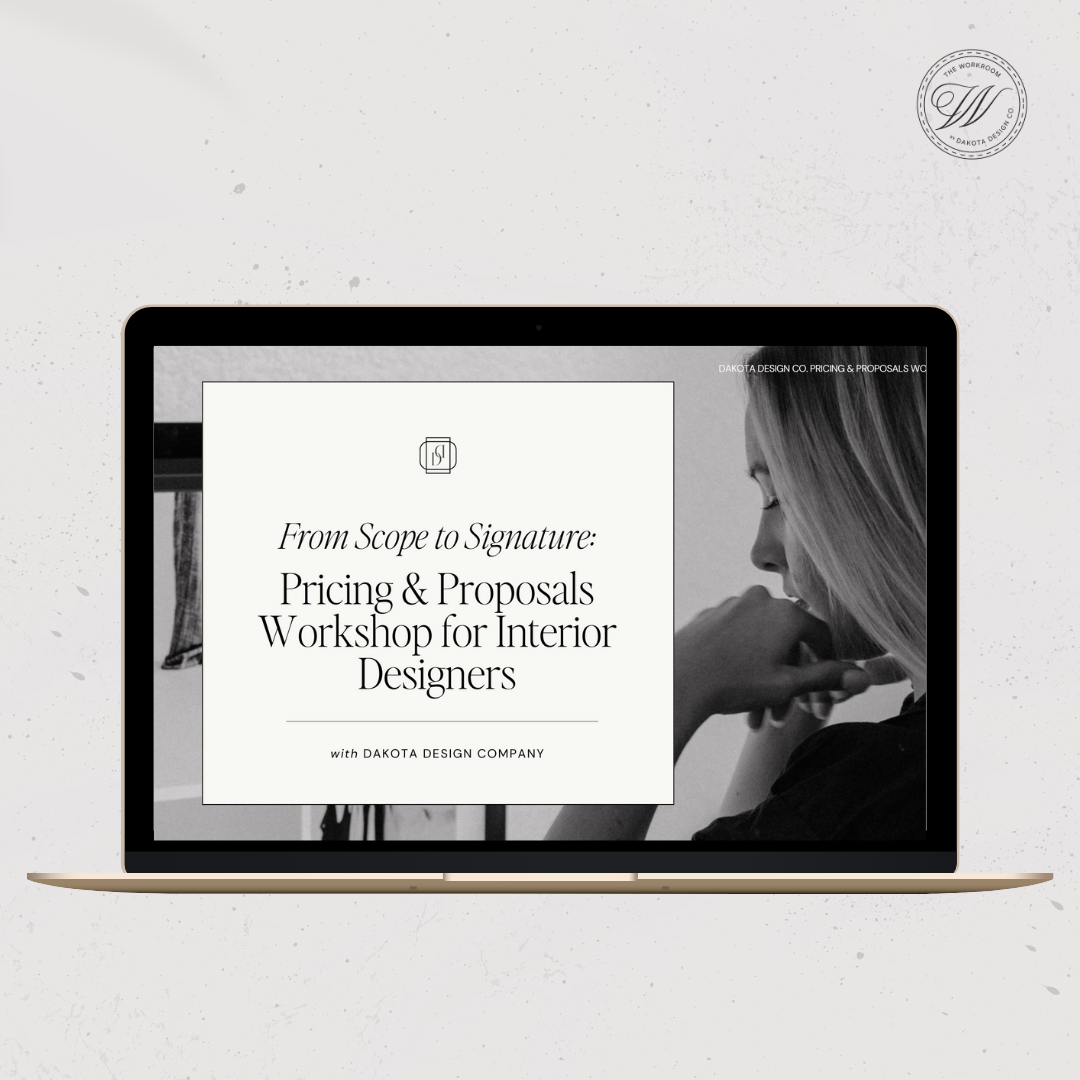
Confident Pricing. Clear Minimums. Higher Profit Margins.
Tired of wondering if you’re charging enough or too much? Ready to set minimums that protect your time and establish pricing that reflects your expertise (and allows you to stand firm when a client pushes back)? Spending days or weeks writing custom proposals that never convert?
Enter: The Pricing & Proposals Workshop.
In this on-demand workshop, you’ll learn exactly how to price your interior design services with confidence, set project minimums that make sense, and stop feeling anxious every time you share pricing with a client.
STRUCTURING YOUR INTERIOR DESIGN SERVICES AS A BRAND NEW DESIGNER
As a brand new designer, you’re probably going to ‘kiss a lot of frogs’ which means you’re going to say yes to a lot of project and client types that you probably wouldn’t even consider 3 years down the road.
But being new means you have to get your feet wet, and the more work you say yes early on, the more experience you’ll get AND the more you’ll learn about yourself and the type of work you are best suited for.
New designers often ask: should I only offer full service because that’s what everyone else does?
My advice: be flexible. The hourly billing will help a ton. And having flexible services where you draw up a scope of work based on what the client needs and what you think will get them the desired result is key. I wouldn’t promote full service design just yet. I would start with the smaller projects and work wtih clients on an hourly basis and then yes, maybe some good clients will end up having you help them all through the entire project (from inquiry to install). But there will likely be some tough clients along the way where you’ll wish you hadn’t included installation or X, Y, Z, because the project is hard, the client is tough, and you feel out of your element.
So, don’t bite off more than you can chew. If you’re new, like I said before, your rate will reflect that, and clients will likely understand that as well.
Regardless of how you serve your clients, you’ll want to the follow the industry standard design process for how you move from initial idea to presentation to installation. We cover that in this blog:
Then, in these two blogs we cover smaller services that could be good options for designers just starting out as they are smaller scopes with shorter timelines. The DBYS is especially ideal because of how flexible it is.
Your Residential Interior Design Contract
Before you take your first client, you need a contract. Not a generic service agreement you found online, and not something you cobbled together yourself. You’ll need a contract written specifically for interior designers, reviewed by an attorney in your state.
A well-written interior design contract does two things that will help you (and your clients) on every project you take on.
It tells your client exactly what to expect from you and what you expect from them.
It establishes boundaries that protect your time, your fees, and your work product.
Scope creep, slow client approvals, payment disputes, and project delays all become significantly harder to manage without a contract that addresses them upfront or provides a process for addressing them when/if they come up.
At the minimum, your contract should cover your fee structure and payment schedule, what is and isn't included in your scope of work, how changes and additions are handled, who owns the design documents, business hours & communication policies, and how either party can terminate the agreement if needed. If you're purchasing product for clients, it also needs to address how that process works.
We have an interior design scope and service agreement in The Design Library that was written specifically for residential designers and is attorney-reviewed. Definitely start there if you don't already have something solid in place. AND, it includes two sample scopes of work to ensure you don’t miss anything when scoping a project.
Also worth reading:
How to use your interior design contract to set better boundaries (and be more profitable)
7 reasons to streamline your design contract process and send contracts quickly
Terms you need in your residential interior design service agreement
Codes, Standards, & Regulations
Any interior designer offering residential design services needs to be familiar with three areas of regulation:
The building codes that mandate requirements for single-family home construction in the US
The legislative picture in the US and Canada regarding interior design licensing and certifications
Interior design credentials and certifications, and the requirements for maintaining them
Building codes are especially important for designers involved in any project that includes construction work. The International Residential Code establishes minimum requirements for single-family homes and is revised every three years. Designers who work on construction projects need to understand what those requirements are and when they apply.
We developed our Residential Building Codes Handbook to cover all code requirements for the spaces designers typically work in. Purchasers receive updated editions each time the code is revised.
Also worth reading:
Does your state require a license to practice interior design?
A breakdown of the most widely respected interior design certifications
Basic Design Principles for New Interior Designers
At Dakota Design Company, we’ve worked with many designers who have an Associate's or Bachelor's degree in interior design. And we have worked with just as many who did not go to interior design school. Either way, there are some basics you MUST KNOW and we have a variety of resources that will help fill gaps in your knowledge base or will refresh things you may have learned decades ago (luckily, we have an interior design professor on our team).
Interior designers need to know (based on the CIDA standards):
How to collaborate with architects, engineers, contractors, tradespeople, fabricators, installers, clients, and other designers
How to develop a successful response to clients’ needs, and to promote health and wellbeing in home environments
How to work through the design process to arrive at a comprehensive design solution that aligns with budgetary restrictions and client needs
How to communicate design intent through a visual and verbal design presentation
Key historical periods and styles of furniture, architecture, and art
The elements and principles of design, which include: pattern, texture, color, scale and proportion, balance, unity, and other strategies
How to integrate light and color to enhance interior spaces
Here are some popular blogs we’ve written on these topics:
Space Planning Standards
There are so many basic, space planning standards and sizes that a designer needs to know: standard counter height, spacing for chairs at a table, minimum circulation space in various rooms, standard furniture and appliance sizes. The list goes on and on!
We developed a comprehensive Size & Standards Guide that is an essential resource for any design studio.

Everything you need to confidently plan residential spaces using essential sizes and standards.
A comprehensive field guide for interior designers who want reliable, real-world measurements for furniture layouts, cabinetry, clearances, and circulation, without spending hours in Google every day.
This 60+ page guide brings together essential residential interior design sizes and standards so you can create functional, well-proportioned layouts that work in real homes, not just on paper.
What’s inside:
Room-by-room standards for furniture sizing, cabinetry dimensions, and space planning
Clearance requirements and layout guidelines for common residential spaces
Key building code considerations related to stairs, circulation, and usability
Human-centered design insights to support comfort, safety, and everyday living
Over 80 clear illustrations to make dimensions easy to understand and apply
This guide is ideal for designers who want a dependable reference they can use during design development, space planning, and layout reviews, and it also serves as an excellent training resource for team members who support space planning.
Note: This guide uses the Imperial measurement system (feet and inches). Metric equivalents are not included.
Products & Materials
Designers need extensive knowledge of furnishings, products, materials, and finishes to arrive at the best design solutions for their clients. This is an area that never stops: trends and tastes change, new products are introduced into the marketplace, and standards change. Staying current with materials knowledge is part of the job at every stage of a designer's career.
Check out some of our recent posts on materials:
Exploring some of the most popular wood species for flooring and cabinetry
The pros and cons of custom, semi-custom, and stock cabinetry
And, be sure to sign up for our free newsletter for designers, The Design Brief®, where Dr. Gloria from our team shares lessons from design school (the same ones she’s teaching up and coming graduates!). Sign up here.
If this felt like a lot, it is. ¯\_(ツ)_/¯
Running an interior design business means you have to have design knowledge + business knowledge. Most people start strong in one and light in the other, and it’s why some designers prefer to work at a firm for other designers or focus on the business and hire a designer to manage the design aspect of their business. It’s not just fluffing pillows, people!
We've worked with enough designers to know that the gaps in business knowledge are almost always the thing that slows a firm down, burns out the team, and eats profits.
If you're just starting out, get the foundation in place first.