
©️ Dakota Design Company 2017-2026 | All rights reserved. This content may not be reproduced, distributed, or used without permission.
WRITTEN BY DR. GLORIA for DAKOTA DESIGN COMPANY
Walk into a room featuring oak flooring or maple cabinetry, and you know exactly what to expect: familiarity, reliability, durability, clean lines. Most often, a project that includes wood flooring or millwork will utilize a native species, such as oak or maple, described in this article. These are the industry workhorses—the steady, dependable materials that are readily available, reasonably priced, and that handle normal wear and tear in home applications.
But an interior space that includes elements crafted from an exotic wood species, such as deep, linear Wenge, or warm, variegated Koa, is something spectacular to behold. These woods are unusual, dramatic, deeply textured, and visually elegant. They provide the ultimate architectural exclamation point in a space.
These wood species are classified as exotic for several reasons, based on geography, biology, and economic supply chains:
These exotic species do not grow natively in North American forests. They are imported from Central or South America, Africa, or Asia
Koa wood is a unique geographic outlier. It grows exclusively in Hawaii, a US state, but because the material must be transported across the ocean, it is categorized under the 'exotic' umbrella.
Domestic hardwoods (such as oak and maple) have predictable visual qualities, with muted earthy tones and standard ring patterns. In exotic species, evolutionary adaptations in tropical or isolated climates have produced much more unusual traits.
For instance, wenge has near-black linear ribboning, ebony has a jet-black marble-like density, and koa has a visual appearance that shimmers like liquid gold.
Tropical climates force trees to grow more slowly to defend themselves against aggressive jungle insects, moisture, and fungi. So, exotic woods typically have higher density and hardness than domestic woods.
Compare that red oak has a Janka hardness rating of 1290—a very hard wood—wenge’s hardness is 1630 and ebony’s is 3000
Whereas domestic woods are harvested from massive, highly-managed forests, exotic woods are defined by scarcity. Many are very slow-growing, often taking decades or centuries to reach maturity.
The harvesting and sale of exotic timber is strictly regulated. Ebony and Wenge are heavily monitored due to historical over-exploitation, and Koa harvesting is strictly protected by Hawaiian state laws.
All of these factors make exotic woods much more costly than domestic species. This chart shows the relative cost of common domestic species (on the right) versus more costly exotics (on the left).
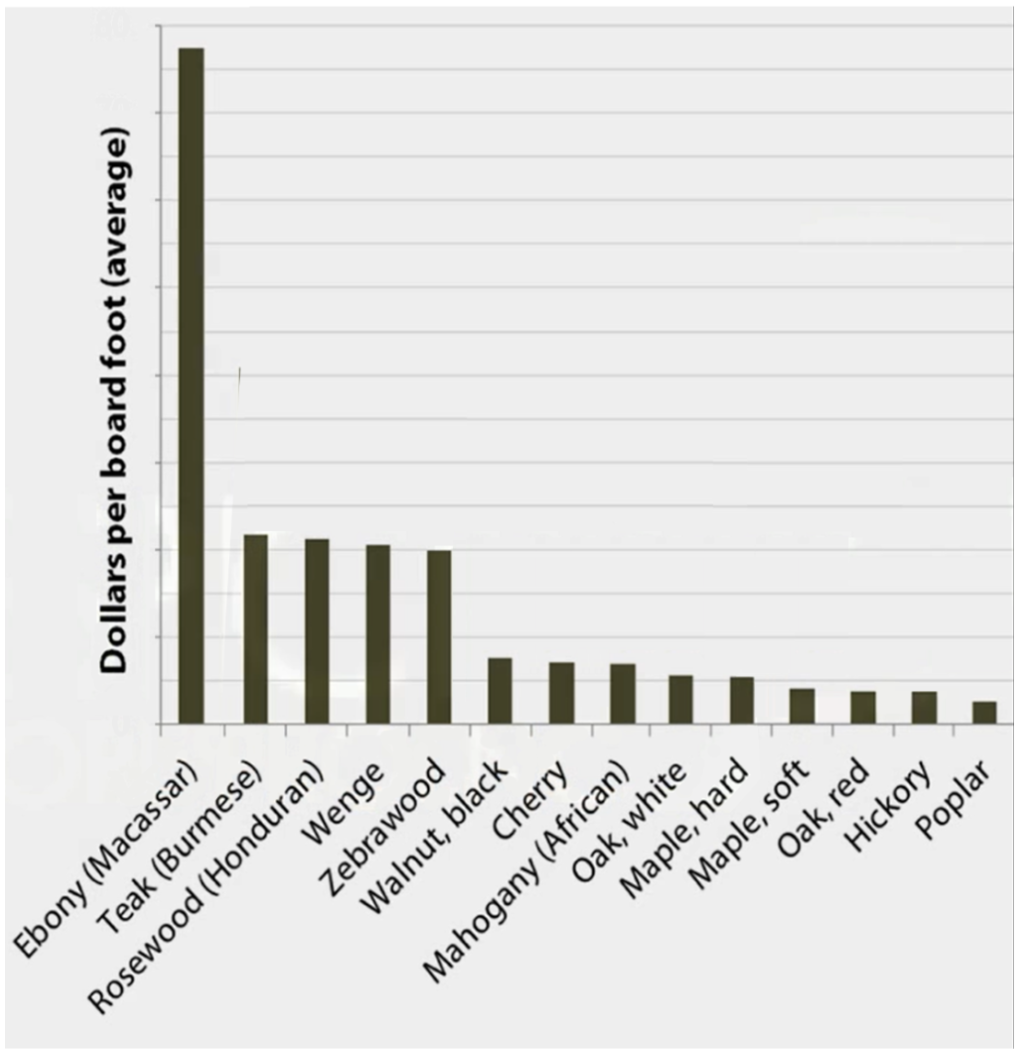
Now, projects and project budgets that align with these specialized and costly wood species are extremely rare. When a generous budget allows, and for clients seeking an interior that tells a richer story, exotic woods offer an immediate injection of drama, deep texture, and undeniable tactile luxury that standard domestic woods simply cannot replicate. Let’s explore a few of these specialized species.
Mahogany - The Quintessential Elegant Wood
The most compelling design characteristic of true mahogany is chatoyancy—a natural optical phenomenon in which the wood appears to have 3-dimensional depth and a luster that changes with the angle of the light, like velvet.

The grain is very uniform, with fine, straight grain lines. Its even texture means it can be cut and carved with great precision, allowing for highly intricate, crisp architectural moldings and details, and it can be polished to a glassy, mirror-like sheen. When cut, the wood is a pale pinkish-brown, but the color will darken into a stunning, dark reddish-brown with a golden luster. It resists warping, shrinking, swelling, and twisting better than almost any other hardwood, making it an optimum choice for high-end millwork.
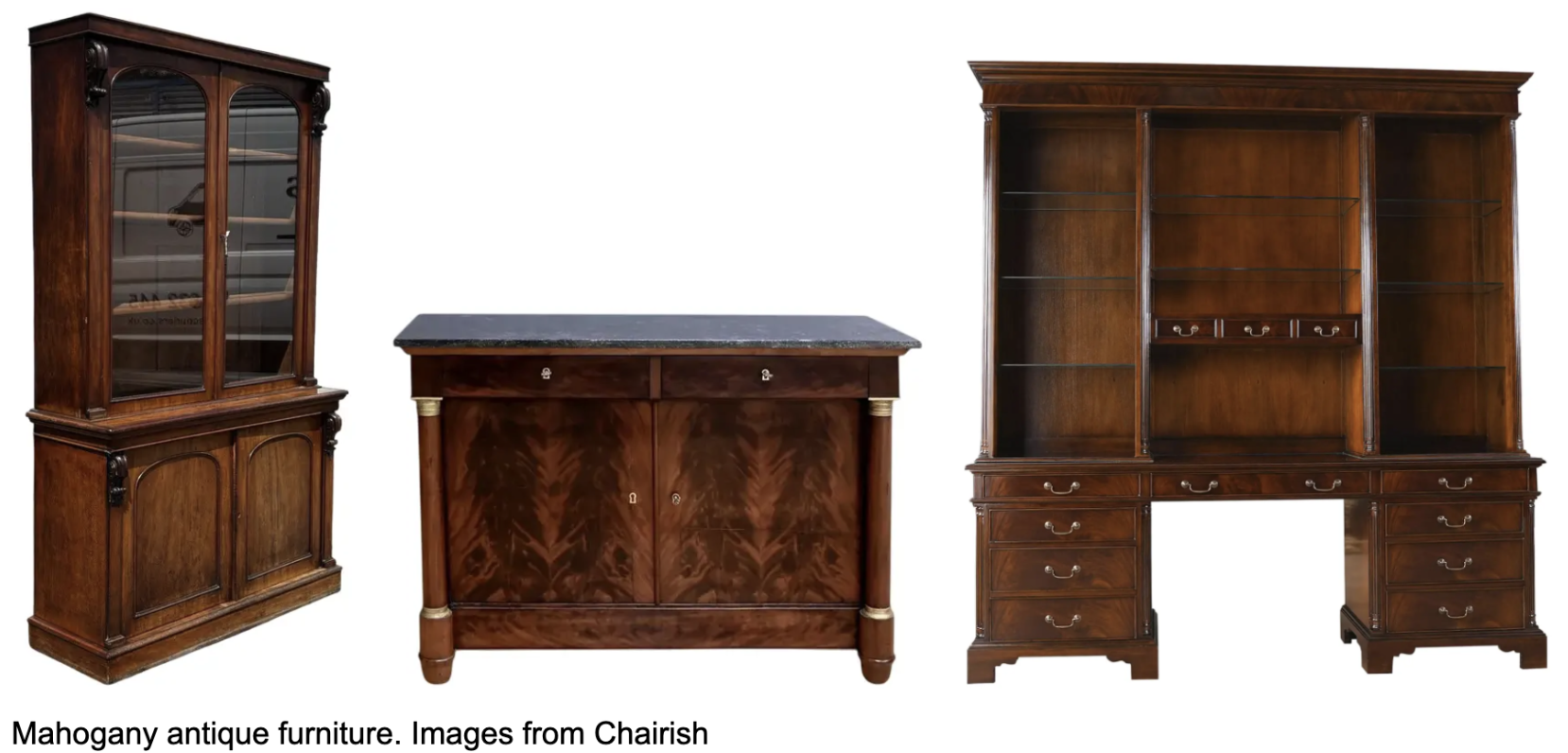
There are a few varieties of mahogany. Honduran mahogany (from Honduras in central America, South America, and other Caribbean locales) is the gold standard for this species, displaying optimal chatoyancy and fine graining. Its grain has a beautiful ribbon quality. It is very expensive, and its harvesting is highly regulated.
African mahogany is a close second, with a slightly coarser texture than the Honduran variety. It is more affordable and widely available. Most luxury residential cabinetry today will utilize this African variety.
Philippine mahogany is at the lower end, is coarser and less stable than the varieties listed above, but is much more budget-friendly. But it lacks the depth of color found in Honduran or African mahogany. All mahoganies have Janka ratings in the low 800s, indicating they are medium-density. Mahogany is an exotic that is not as dense and hard as other exotic species.
Historical Perspectives on Mahogany
Naturally, a wood as beautiful as mahogany has been favored by many furniture designers over the centuries. Mahogany was the principal wood used by Thomas Chippendale and his contemporaries in the mid-to-late 1700s, during Britain's Georgian period. Mahogany was brought to Europe from Central and South America.
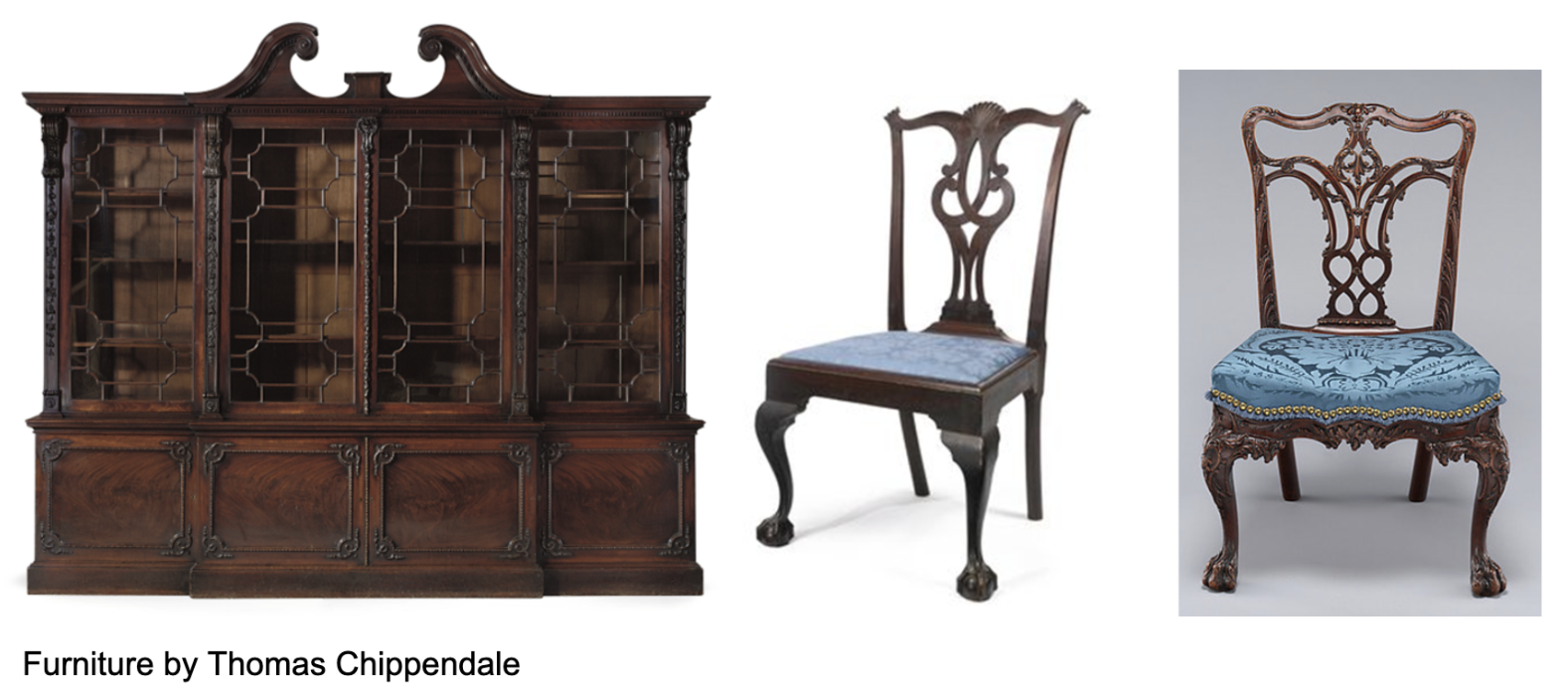
And in the early 1800s, mahogany defined the French Empire (pronounced UHM-peer) style, featuring militaristic motifs honoring the conquests of Napoleon Bonaparte.

Zebrawood and Tigerwood - Animal Stripes in Wood!
Zebrawood and Tigerwood are often mentioned in the same breath because of their wildlife-inspired names, but from a design perspective, they are two completely different animals. They bring entirely different rhythms, color temperatures, and structural behaviors to a space.
Zebrawood is a bold, linear, strikingly graphic wood sourced primarily from West Africa, featuring a mid-toned creamy background with narrow, dark brown to black stripes. The cut matters; to get that iconic "zebra stripe" look, the wood must be quarter-sawn.
Zebrawood can be incredibly challenging for woodworkers. It has an interlocking grain, meaning the wood fibers twist and change direction. When planing or routing, it can tear out easily. It is also a reactive wood that moves significantly with changes in humidity. For this reason, zebrawood is often used with a substrate in an engineered wood application.
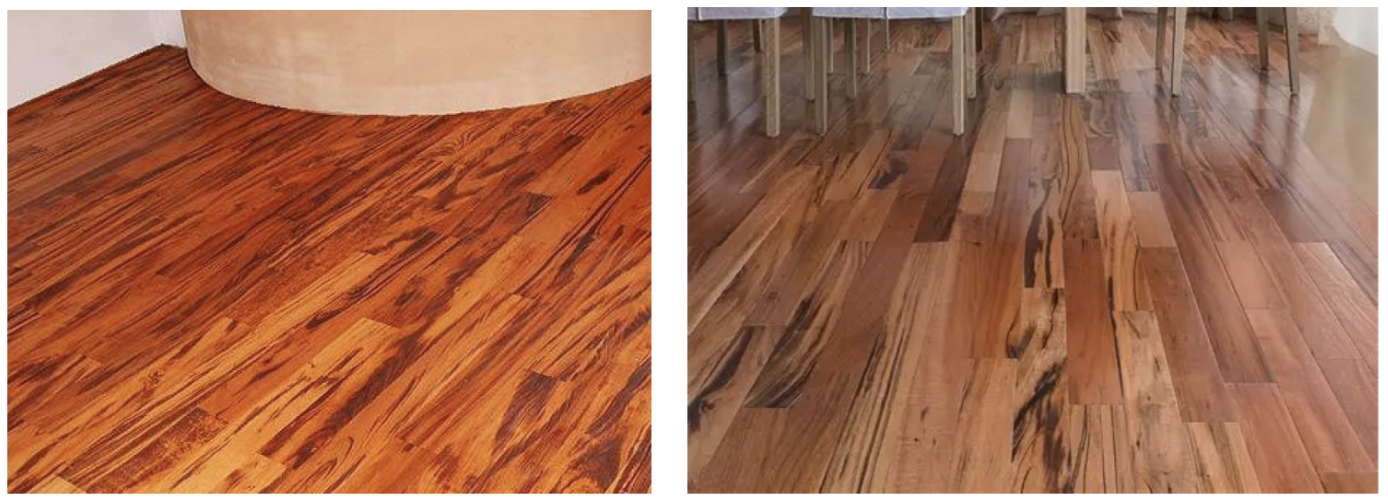
Tigerwood, usually sourced from South Africa, on the other hand, is a very hard and stable wood. It has a background of rich reddish-brown or golden tan, with irregular streaks of dark brown or black that mimic the coat of a tiger.
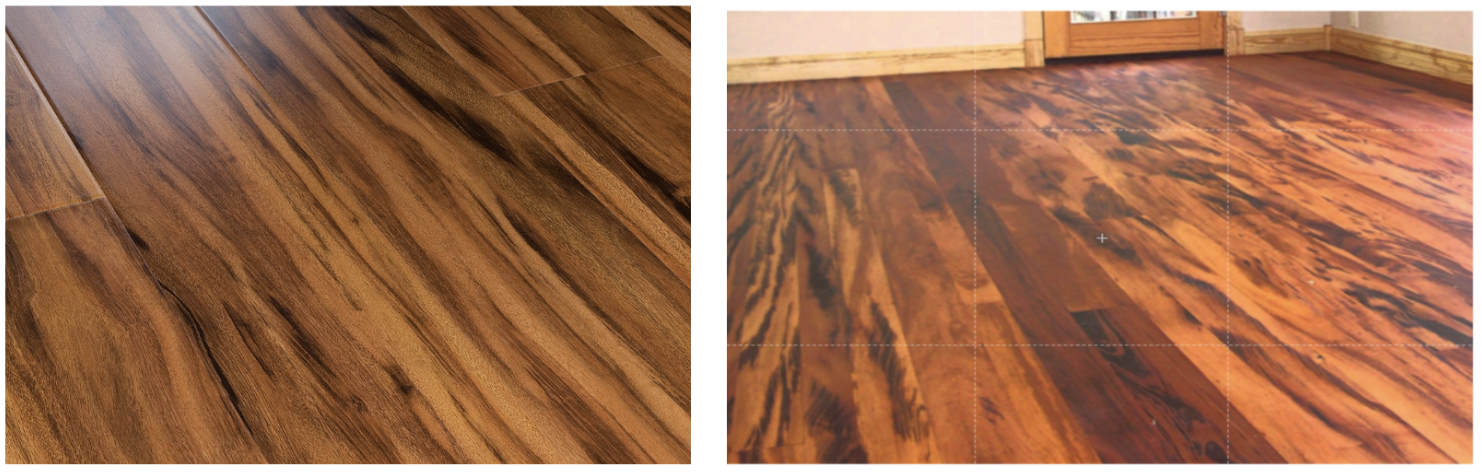
Tigerwood is very hard and stable, so is a great choice for high-end flooring and statement cabinetry. Whereas red oak has a Janka hardness rating of 1290, considered quite hard, Tigerwood boasts a Janka rating of 2160!!! significantly harder than all domestic woods.

Wenge - The Ultimate Dark Wood
Like mahogany, wenge is a luxurious and sophisticated dark wood. It is remarkably hard, with a Janka rating of 1,630. Sourced from Central Africa, it is also very expensive and suitable only for high-budget applications.
It is a rich, deep espresso-black. While it appears almost completely black from a distance, up close it reveals a mesmerizing tapestry of dark chocolate brown interlaced with very fine, lighter yellowish-brown lines.
Wenge is typically specified as quarter-sawn, which yields a tight, uniform, ribbon pattern. Unlike mahogany, which often has a high-gloss finish applied, wenge looks its absolute best with a low-sheen or matte finish, which preserves its raw, interesting texture.

Rosewood - A Real Stunner!
Like cherry and mahogany, and as the name would imply, rosewood has a distinctive reddish tone. But it has more color variation than the other rose-toned hardwoods. It can also include hues of purplish-brown, chocolate, and brick red in very dramatic grain patterns.
It is extremely hard, with Janka ratings of 1,280 to 2,440 depending on the exact species. It has a medium-to-coarse texture, so is often finished with a high mirror-polish.
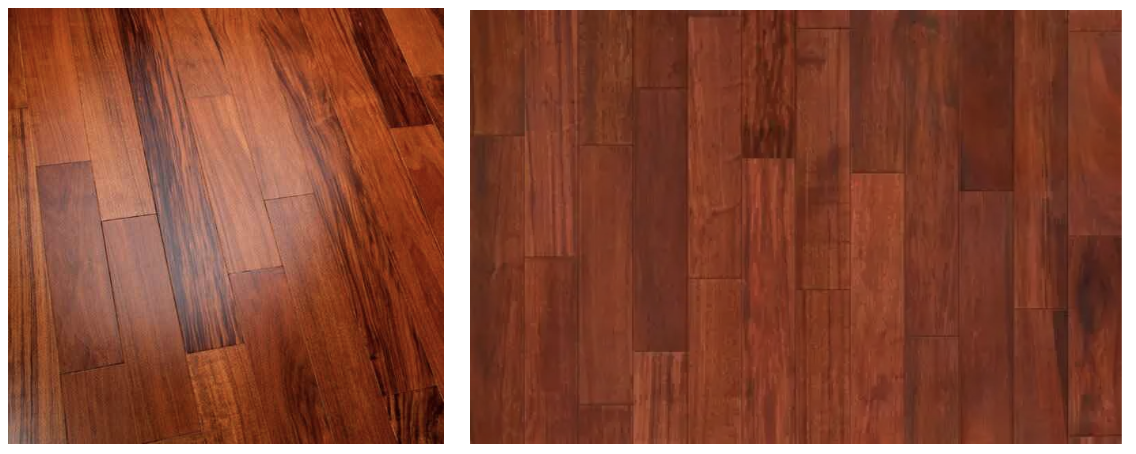
Rosewood is often used for the bodies of high-end violins and guitars. It is sourced from India, Central and South America. It has experienced historic over-harvesting, so must be procured from ethical harvesters. Because of its high cost, it is appropriate for high-end statement pieces.

Acacia and Koa - A Distinction Worth Clarifying
Koa wood is a type of acacia wood. Acacia is a massive botanical genus containing over 1,300 different species of trees. You will often find very reasonably priced Acacia furniture in chain retail stores.
The scientific name for Koa is Acacia koa. So, botanically speaking, Koa is a member of the acacia family. But, to consider them the same would be like comparing a mass-market canvas print to an original oil painting.
When a retailer sells an acacia dining table or flooring, they are almost always using fast-growing, highly abundant species from Asia or Australia. When someone sells Koa, they are strictly referring to Acacia koa, a highly protected, slow-growing tree that grows exclusively in Hawaii, and nowhere else on earth. Acacia koa has a Janka hardness rating of 1,170.
While both Acacia and Acacia koa woods feature an interesting variegated grain, Koa—like mahogany—possesses that rare optical property called chatoyancy. When polished, Koa doesn't just look multi-toned—it reflects light in a way that makes the wood look three-dimensional and shimmering. Standard acacia (top row below) has an interesting grain, but it lacks that deep, 3-dimensional luster of Koa (bottom row below).

Ebony - the Most Elite Exotic Wood
Sourced from parts of Africa and Southeast Asia, this is the most elite, historically prized luxury wood, revered for its unique black appearance. Gaboon Ebony is famously a solid, jet-black velvet color with almost no visible grain. Macassar Ebony features a dramatic, striped "canvas" of black ribbons alternating with warm brown and caramel bands. It has an incredibly fine texture that feels like polished marble or silk. Ebony has an extremely high Janka ranking of around 3,220!! This unique wood is very black and very hard!!

Because of its high cost and unusual appearance, ebony is appropriate for inlay detailing, decorative furniture trim, and high-end statement accents. It is far too expensive and rare to use for full-scale flooring, but it serves as the ultimate jewel of interior millwork.
Historical Perspectives on Ebony
It is a common belief that early piano keys were made of solid blocks of ivory (white keys) and ebony (sharp and flat keys). This is not entirely accurate. The black keys were made of a solid wood like pine or basswood, then covered with a veneer of black ebony.
The white keys were similarly made from a less expensive wood material, then covered with thin strips of ivory, harvested from elephant tusks. This was standard until about the 1960s, when piano manufacturers recognized the ethical implications of ivory usage. In 1989, there was a complete ban on the trade of ivory.
Unlike ivory, ebony is not subject to an outright ban, but it faces severe sourcing restrictions due to deforestation. And, true jet-black Gaboon ebony is astronomical in price. Today, black and white piano keys are made of plastics and resins.
Ipe and Teak - The Ultimate Outdoor Woods
Ipe wood, native to Central and South America, is related to the Walnut species. It is astronomically hard, boasting a Janka hardness rating of 3,500. It is the ultimate wood for projects requiring absolute resilience to the elements.
Its color ranges from deep olive-brown to deep reddish-brown, with near-black grain streaks. Its grain and texture are dense and uniform. It is rarely used for indoor cabinetry. Instead, it is the premier choice for high-end luxury indoor/outdoor flooring, sunroom decks, or architectural cladding. An oil finish treatment must be reapplied annually.
Sourced primarily from South and Southeast Asia, teak is a luxury hardwood uniquely suited for both indoor and outdoor use. Its color is a tawny brown that mellows with age to a uniform honey hue. It has a straight, occasionally wavy grain, a dull luster, and a distinctly oily, tactile feel. Because of its high natural oil content, it is highly resistant to water, rot, warping, and pests. While softer than oak at 1,070 on the Janka scale, it derives its structural integrity from its unique chemistry rather than sheer density.
Teak is appropriate for bathroom vanities, wet-room cabinetry, outdoor furniture and decking as well as indoor furniture. Teak furniture was very popular during the mid-century modern period.


Why it Matters
Interior designers are responsible for possessing a broad base of knowledge - everything from historical styles of architecture and furniture, to methods of construction, to environmental systems, to lighting technology, to color theory. Having a broad-based knowledge of a wide variety of materials used in interior environments is just one of the many parts of an interior designer’s body of knowledge. Having a good understanding of the various qualities of different wood species is right up there in importance. A client may have an antique mahogany sideboard from their great-grandmother, or a rosewood clock purchased on a European trip. Or, they may ask whether it is practical to install koa flooring.
We are committed to keeping you informed about everything an interior designer needs to know!!!
Read More Articles in Our Wood Series:

Want The Design Brief® delivered straight to your inbox?
If you liked this email, be sure to sign up for The Design Brief®, our complimentary publication that gives you bite-sized lessons on all the technical interior design topics you didn’t learn (or forgot) from design school—straight from our resident tenured interior design professor!