The Design Brief® | THE CABINET SERIES: Tackling the Peskiest Kitchen Planning Issue: Cabinet Corners

©️ Dakota Design Company 2017-2026 | All rights reserved. This content may not be reproduced, distributed, or used without permission.
WRITTEN BY DR. GLORIA for DAKOTA DESIGN COMPANY
In other posts in this KITCHEN CABINET series, we looked at cabinet fabrication and cabinet styling. Here, we will look at problem-solving one specific cabinetry solution.
Whether you are a novice kitchen planner or have been designing kitchens for years, one of the peskiest dilemmas is how to handle interior cabinet run corners. Cabinet corners present two problems: storage capacity and access. This post breaks down the options to maximize both.
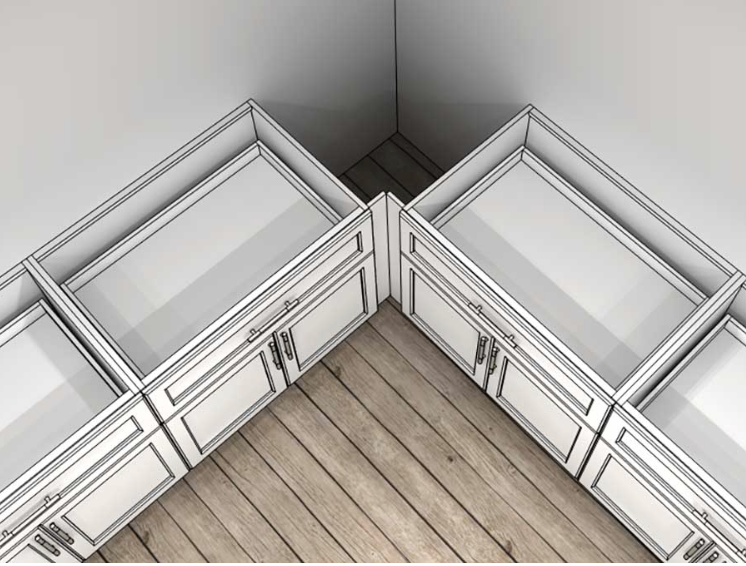
The Corner Dilemma
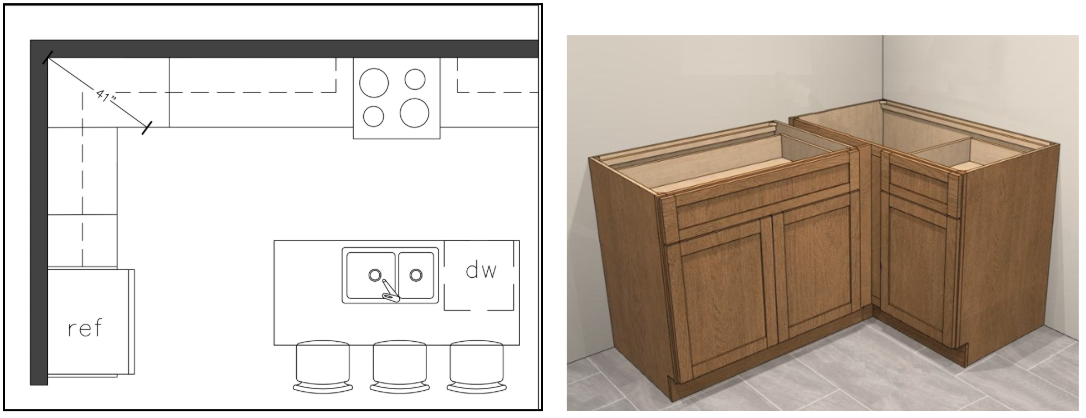
The interior corner, where two base cabinet runs meet at an interior L-shaped corner, presents a utilization challenge: how to use that space for storage while keeping the cabinet contents easily reachable. If no cabinet is placed in the corner, as pictured above, capacity is lost. But when that space is captured within some type of corner cabinet, often the problem is that the contents in the back cannot be seen or reached comfortably. So, accessing items necessitates unloading the contents of the entire cabinet in order to reach the items in the back.
The base (or lower) cabinet corners present a greater challenge than the upper (or wall) cabinet corners simply because of the cabinet depth. Accessing the corner of 12” deep upper cabinets is not such a great problem. Upper cabinets are shallow, and the extents of the corner are easier to reach.
To reach base cabinets, one needs to stoop or bend, which limits arm reach.

Base cabinets are 24 inches deep, but the geometry of a triangular corner means that, at its deepest point, the back recess of the corner is 34” to 36” deep, as shown below. That is deeper than an arm can reach. Herein lies the problem.

One very basic solution is the corner cabinet with an angled front, which creates a situation where the reach depth is even deeper—43” or more. One would need to get onto the floor and crawl halfway into the cabinet to access the far reaches.

The “blind corner” configuration has a similar reach-range issue, with an interior depth far greater than a human arm can reach. Here, a standard base cabinet is butted up to a base cabinet that goes back to the corner, but has only a small door from which to access the space under the drawer, which goes all the way back to the corner. Kneeling, stooping, and reaching all come into play to access the back recesses.
The Tried-and-True Lazy Susan
By far the most-used corner solution for inside corner base cabinets is the lazy susan. A lazy susan cabinet is a corner base cabinet with rotating circular shelves, allowing access to items stored deep inside. Instead of reaching all the way back inside, you can rotate the shelves to bring stored items forward to the cabinet opening.

While the 135-degree spinning shelf has been a staple for decades, there are several issues that prevent it from being the end-all solution for corner cabinets: the shelves, supported by the single center pole often do not have the weight capacity to hold heavier pots and pans, items fall off the shelves into the back into the dark abyss in the way back corner and become very difficult to retrieve, cleaning the void spaces around the shelves is problematic; and accessing items still does require stooping, bending and reaching.

21st Century Solutions: There Must Be Something Better, Right???
Some of the more effective solutions are accessory pieces available today fit inside either a lazy susan or a standard blind-corner base cabinet. Several are described below.
The Super Susan - A Step Above
A standard lazy susan uses two rotating shelves supported by a center post. This minimizes each shelf’s weight capacity, because the support is in the center rather than the edges. A Super Susan goes beyond by mounting each wooden tray directly onto a fixed, heavy-duty rotating swivel bearing anchored to a stationary cabinet shelf or the cabinet floor.
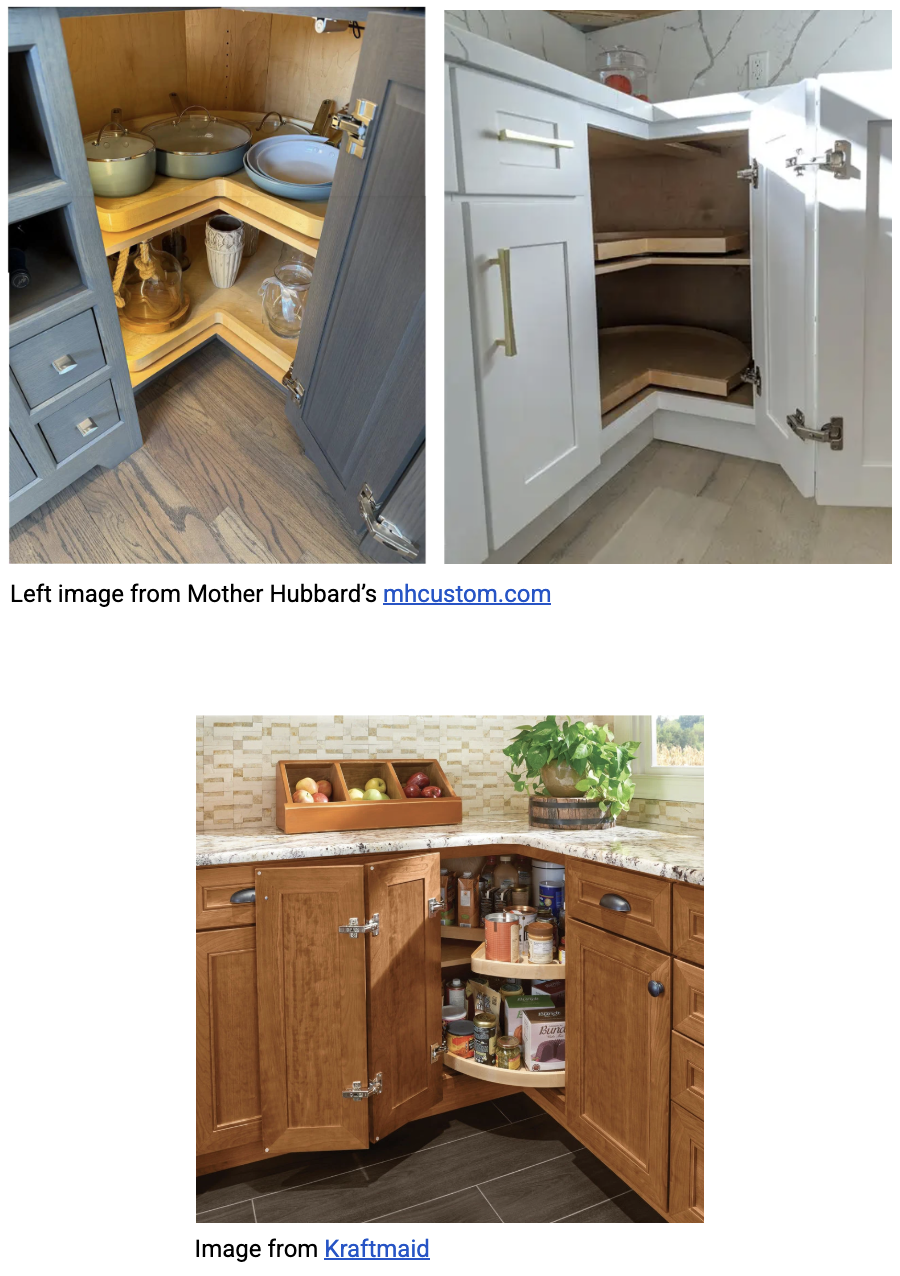
Kraftmaid and other manufacturers make Super Susans—rotating, pie-shaped shelves that rest on a solid wood shelf with a concealed bearing mechanism. The weight-bearing capacity is typically 60 to 80 pounds per shelf, significantly higher than a lazy susan shelf supported by a center pole. Other manufacturers produce just the heavy-duty bottom-mount swivel bearings for center-post-free corner Susan installations.
Multi-Tier Swing-Out and Articulating Systems for Blind Corner Cabinets
For blind corner cabinets—where a standard base cabinet extends deep into a corner and is only partially accessible through a smaller door opening—several accessories can be installed within the cabinet's concealed portion.

Kesseböhmer, a German company specializing in residential storage solutions, makes blind corner cabinet components that allow visual and physical access to all stored items.
Their most innovative corner cabinet hardware component solution for blind corner cabinets is the LeMans. It is two (upper and lower) kidney-shaped shelves that both pull out and swivel from a blind corner cabinet. By bringing the shelves and cabinet contents out of the cabinet, the entire contents are completely visible and easy to retrieve. Each shelf pivots and extends, and each shelf holds over 55 pounds.

Another blind corner cabinet hardware solution built by Kesseböhmer is the Magic Corner. Here, an upper and lower shelf connect to the back of a cabinet door. When the door is pulled open, the connected shelves extend forward into the kitchen, and also pull another set of shelves from the back recesses of the corner cabinet out to the cabinet opening.
As the door and connected shelves are pushed back in, the interior upper and lower shelves move to the back of the cabinet space, and the two sets of shelves stack neatly side by side within the cabinet cavity.

Both Peka (a Swiss company) and Häfele (a German company) make extending blind corner cabinet hardware similar to those made by Kesseböhmer. With Peka’s Magic Corner II Comfort, the blind corner cabinet’s door swings open, the near shelves behind the cabinet door swing out into the space, the shelves from the rear section glide to the open door area and can also be pulled out into the space. Everything stored inside is easy to see and unload.

Lest we think all cabinet accessory innovation comes from northern Europe, an American company, Rev-A-Shelf makes a wide variety of blind corner cabinet accessories, some similar to those by Kesseböhmer and others.
Their Elite Blind Corner Optimizer has upper shelves that slide independently from the lower ones. Available in two- or three-tier configurations, it operates similarly to other options, with the near shelf coming out into the space first, followed by the shelves from the rear section. All shelves pull out into the space.
With Rev-A-Shelf’s ‘Curve’ Contemporary Blind Corner, either a single or a double door front swings open with the swivel-out shelf attached to it. Like the Magic Corner, the Two-Tier Blind Corner Optimizer has baskets attached to the back side of a cabinet door. When the door is pulled open, the front baskets follow along, while the rear baskets move into view. Each rear basket can then be independently pulled open. The ‘Cloud’ Contemporary Blind Corner features cloud-shaped shelves, similar to Kesseböhmer’s kidney-shaped LeMans.
Rev-A-Shelf also makes half-moon-shaped wood and wire shelves to pivot out from the blind corner recess.
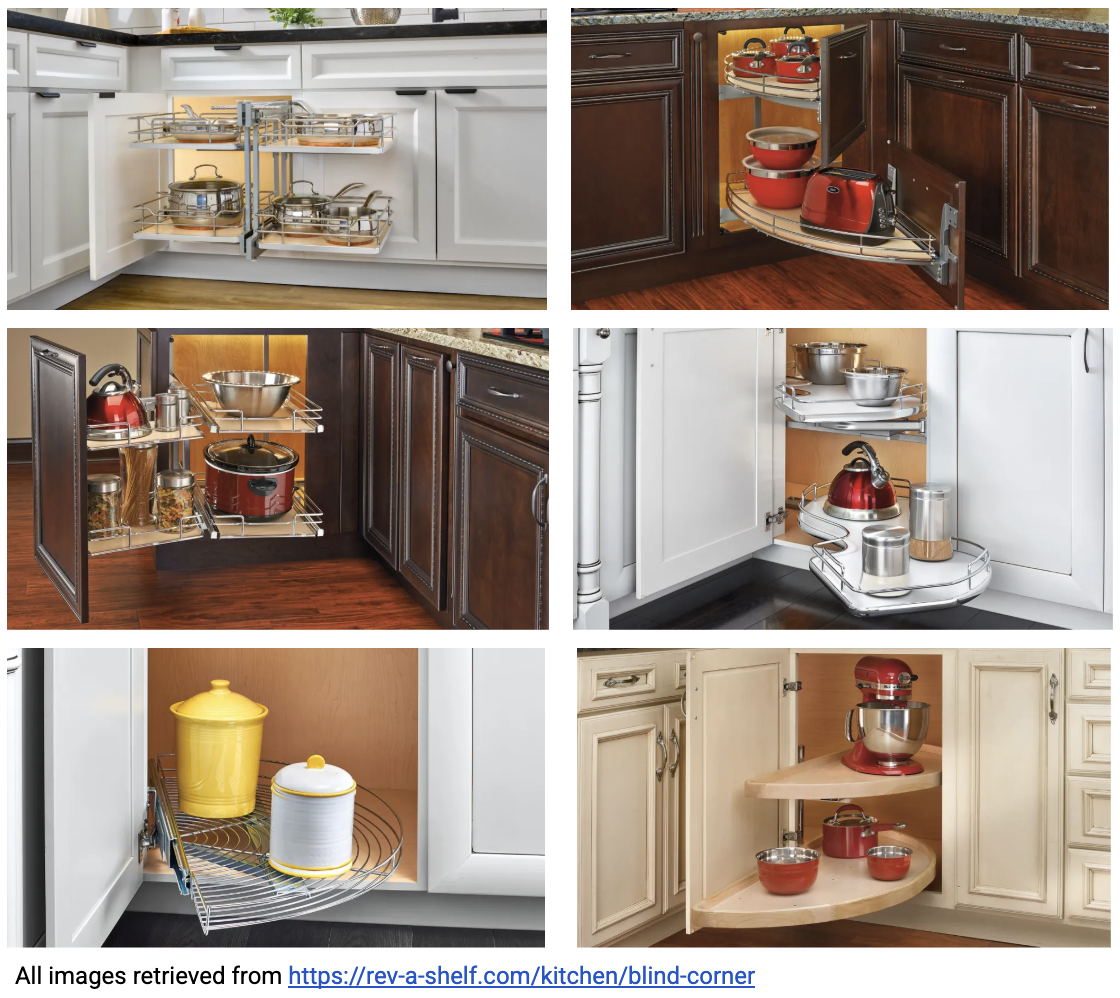
All these hardware options for blind corner base cabinets require precise templates and a complex installation onto cabinet side panels.
What Else is Available??
All of the hardware accessory solutions pictured above are for blind corner cabinets—where a standard base cabinet extends deep into a corner and is only partially accessible via a small door opening that clears the adjacent base cabinet. The solutions above rely on additional hardware pieces that are installed within a blind cabinet base. Here, you need to deal with two manufacturers: the cabinet manufacturer and the add-on accessory piece manufacturer.
Some kitchen cabinet manufacturers offer another solution. It is a stack of corner drawers that fit into a corner cabinet. The drawers are built in a V-shaped (90-degree angle face) multi-sided drawer box and utilize full-extension undermount drawer slides.
As with the swing-out shelf accessories, items are much easier to access when pulled out into the room, rather than requiring someone to stoop and bend to retrieve them from the cabinet cavity.

The drawer contents are easy to access, but the full corner isn't fully utilized.

Several cabinet manufacturers make these corner drawer units. Kraftmaid/Kraftmaid Reserve makes a corner base cabinet with three drawers that include high-capacity undermount slides.

Wellborn Cabinets also manufactures a corner drawer base that supports up to four custom-angled drawers in a single corner carcass through its Premier and Estate Series. It is designed to maximize the deep footprint for large pots, pans, or dry goods. Many other cabinet lines offer similar corner drawer units.
For custom cabinet projects, if a cabinet maker does not want to build these specialized corner drawer boxes, they can be ordered already-made from Eagle Woodworking in maple, white oak, or walnut. These boxes fit snugly into deep corners and accommodate standard heavy-duty undermount slides.

When specifying these corner drawers, one design dilemma is drawer pulls, since you can't place one at the center of the drawer at the inside of the 90-degree corner. Matching pulls or knobs on each side of the angled face, or minimalist edge pulls along the top edges, work best.

On The Horizon
A company called FurniFlex 3d posts YouTube videos and Instagram Reels of a very innovative spinning corner drawer component.

However, these images are 3D concept renderings, and no such circular drawer box, internal circular track mechanism, or multi-axis rotating slides are currently manufactured anywhere by FurniFlex or any other company. So, don’t be fooled by these slick AI-generated videos of this incredibly great solution. Maybe in the future……
Sources Used:
Panero, J. & Zelnik, M. (1979). Human dimension & interior space. Whitney Library of Design.

Want The Design Brief® delivered straight to your inbox?
If you liked this email, be sure to sign up for The Design Brief®, our complimentary publication that gives you bite-sized lessons on all the technical interior design topics you didn’t learn (or forgot) from design school—straight from our resident tenured interior design professor!